Skydiving: what it is, how it works and how to start (2026 guide)
Updated on October 13, 2026 · 13 min read
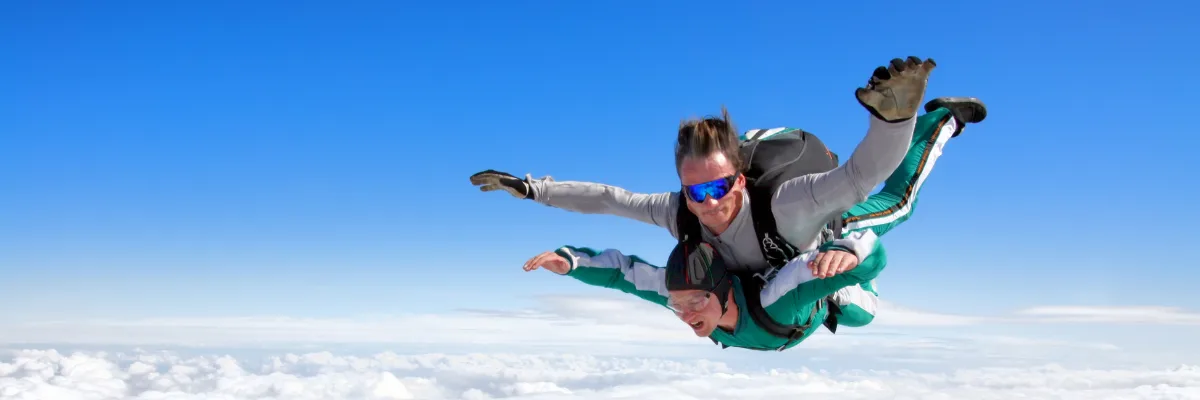
Skydiving is an experience that combines adrenaline, freedom and personal challenge. The mere thought of jumping from a plane thousands of metres up may seem crazy, but those who have tried it describe the experience as memorable.
In this article you'll discover what skydiving is, how a jump works, the main types of jump and disciplines, the equipment, how safe it is, how much it costs and where to jump in Italy.
What is skydiving?
Ready to jump? Book your tandem with no advance payment.
Book nowSkydiving is jumping from an aircraft in flight, falling freely for a while and then opening a parachute that slows you down until you land. In Italian it is called paracadutismo: both words mean the same thing, a jump with freefall followed by a flight under the canopy.
There are three ways to do it: as a one-off experience, with a tandem skydive harnessed to an instructor; as a sport, after a course and a skydiving licence; and in the military. Sport jumps take off from drop zones, airfields equipped for skydiving, such as our skydiving school near Milan, Italy.
Skydiving: the quick answers
If you are looking into skydiving for the first time, these are the five things you want to know straight away. Each answer links to a full article on the subject.
- What altitude do you jump from? Our aircraft climbs to 4,200 metres, among the highest altitudes used for tandems in Italy. The details are in what altitude you skydive from.
- How long is the freefall? About 50-60 seconds, with speed settling at around 200 km/h. All the numbers are in how long freefall lasts and how fast you go.
- How much does it cost? A tandem jump is €180 on weekdays and €200 at weekends. The full comparison is in our guide to skydiving prices in Italy.
- What is the minimum age? 16 with parental consent, and there is no upper age limit. The full picture is in the minimum age for skydiving.
- How safe is it? On a tandem every phase is handled by an instructor, and every rig carries a reserve parachute and an automatic activation device. More in how safe skydiving really is.
Here are the same numbers in order, from the moment you leave the aircraft to the landing.
| Stage of the jump | Numbers |
|---|---|
| Jump altitude | 4,200 metres |
| Climb to altitude | about 25 minutes |
| Freefall | 50-60 seconds at around 200 km/h |
| Parachute opening | around 1,500 metres |
| Flight under the canopy | 5-10 minutes |
| Full experience | 2-3 hours, from arrival at the airfield to landing |
How does a parachute jump work?
Tandem skydiving is an experience that combines adrenaline, technique and a deep connection with the outdoors. Whether you're a beginner or an aspiring skydiver, understanding the stages of a jump is essential to fully enjoying this adventure.
- Preparation: before the jump you take part in a briefing where the instructor explains the procedures, the correct freefall position and the landing (we recommend comfortable clothing and trainers).
- Climbing to altitude: you board the aircraft and climb to 4,200 metres. This phase takes about 25 minutes.
- The jump and freefall: once you are out of the aircraft you experience freefall for about 50-60 seconds, at a speed of around 200 km/h.
- Parachute opening: at around 1,500 metres the instructor, or the solo skydiver, opens the canopy and the descent continues for 5-10 minutes. If the main parachute did not open, don't worry: there is always a reserve.
- Landing: the skydiver steers the canopy to a soft landing in a safe area.
From take-off to landing the jump takes a little over half an hour, while the full experience — arrival, briefing, kitting up and the jump — takes 2-3 hours. The adrenaline it leaves behind, on the other hand, lasts a lifetime.
The history of skydiving
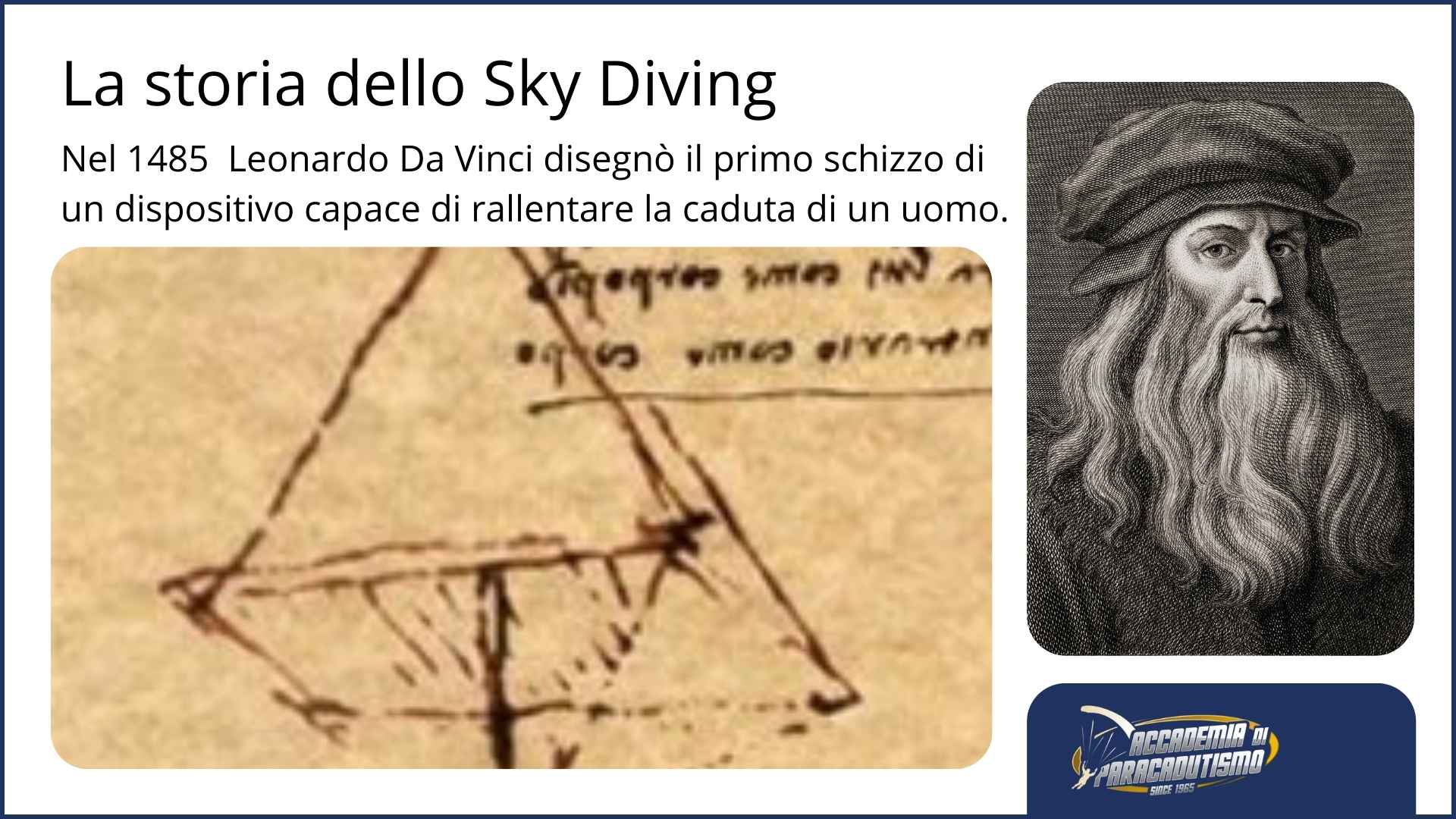
The idea of a parachute was born in the Renaissance with Leonardo da Vinci. In 1485 he drew the first sketch of a device capable of slowing a man's fall. The first documented jump happened in 1797 thanks to André-Jacques Garnerin. In fact, André, once he reached a jump altitude, threw himself from a hot air balloon with a rudimentary parachute.
Types of Parachute Jumps
Tandem Skydiving (ideal for first-time skydivers)
The tandem jump requires the participant to be securely attached to an experienced instructor using a special harness (therefore two people). The instructor manages all phases of the jump, from exiting the plane, during freefall, to landing, allowing the passenger to enjoy the experience in complete safety.
AFF Course (Accelerated Free Fall)
For those who wish to become an autonomous skydiver, the AFF Course represents the standard training program. Perhaps also the most comprehensive when it comes to skydiving. This intensive program consists of theory lessons and you'll be able to make several practical jumps, initially assisted by one or more instructors.
Sport skydiving
For those who have experience, there are disciplines such as freefly, wingsuit flying and relative work, which allow you to evolve as a sky athlete.
Tandem or AFF course: where to start
Almost everyone starts with a tandem: it is the only way to jump with no preparation at all, and you simply book a date and turn up on the day. The AFF course answers a different goal, which is becoming a solo skydiver.
A tandem is a one-off experience: you are attached to an instructor who handles the exit, the freefall, the opening and the landing, and all you have to do is look around. AFF is a path of 7 levels, each with a jump from 4,200 metres: on the early levels you fly with two instructors, then with one, until you are fully independent. There are no fixed dates and it fits around your own pace.
Many people do a tandem first to find out whether skydiving is for them, and only then sign up for the course. The path is described level by level in our article on the AFF skydiving course, while costs and enrolment are on the AFF course page.
How to become a skydiver
To jump on your own you need a skydiving licence. In Italy it starts with a course at a school authorised by ENAC, the Italian civil aviation authority: today it is almost always the AFF course, with a day of theory and 7 levels of jumps with instructors. After the course you complete the jumps and tests required for the licence, and from then on you jump on your own.
Requirements, number of jumps and timing are explained step by step in how to get a skydiving licence; our course programme is on the AFF course page.
Sport skydiving disciplines
Once you have your licence, skydiving becomes a sport with many specialities. The main ones are:
- Formation skydiving (or relative work): several skydivers build set formations in freefall, flying belly to earth.
- Freefly and VFS: flying upright too, head-up or head-down, at higher speeds; VFS (Vertical Formation Skydiving) is the team version.
- Wingsuit: a suit with fabric wings between the arms and legs turns the fall into a glide.
- Canopy piloting: the competition happens under an open canopy, with fast passes just above the ground or water.
- Accuracy landing: you have to touch down as close as possible to the centre of a target just a few centimetres wide. It is one of the oldest disciplines.
- Speed skydiving: the goal is maximum vertical speed in freefall, measured with GPS instruments.
How these specialities are changing is covered in competitive skydiving in 2026.
Skydiving equipment
The system a skydiver wears on their back, the container, holds two parachutes: the main and the reserve, used if the main has a problem. There is also the automatic activation device (AAD), which opens the reserve by itself if the skydiver is still falling too fast at a set altitude.
The rest is simple: a harness, an altimeter to always know your altitude, a helmet, goggles and a jumpsuit. In a tandem the instructor wears the parachute system and the passenger is attached to them with their own harness: all you need is a jumpsuit, helmet and goggles, which we provide.
How safe is skydiving?
Much safer than most people think. According to the United States Parachute Association (USPA), in 2025 there were 0.46 fatalities per 100,000 jumps in the United States; in 2024 the figure had dropped to 0.23, the lowest since records began. In 1961 it was around 11 per 100,000.
This is mainly thanks to the equipment, with a reserve parachute and an automatic activation device, and to increasingly structured training. In a tandem, every decision is made by an experienced instructor. All the figures are in how safe is skydiving.
Sport and military skydiving
Skydiving has a long military history, and armed forces still train their own paratroopers with a path and a licence that differ from civilian ones. Sport skydiving is open to everyone: you start with a tandem or the AFF course at a civilian school. The differences between the two are in how to get a military parachutist licence.
How Much Does It Cost to Skydive?
Prices for a parachute jump vary based on the type of experience chosen and the location:
- Tandem jump: the price depends on the centre and the altitude; with us it is €180 on weekdays and €200 at weekends and on public holidays, with photos and video extra.
- AFF Course: the price varies from school to school; with us it starts from €1,500, covering theory and the seven levels, with all equipment included during the course.
- Personal parachute: if you want to practice sport skydiving, you will have to buy one, whose price per parachute ranges between €3,000 and €7,000.
Many centres offer group discounts or special packages with video and photos of the jump, so you can immortalize the experience. You can find all the up-to-date details on our prices page.
At our Casale Monferrato dropzone a tandem jump is €180 on weekdays and €200 at weekends and on public holidays, with photos and video available separately and gift vouchers valid for 12 months. For a comparison with other Italian schools, the full read is our guide to skydiving and tandem jump prices in Italy.
Where to Skydive in Lombardy and Piedmont?
Northern Italy offers some of the best destinations for skydiving, thanks to breathtaking scenery and certified skydiving centres. Among the best locations are:
- Casale Monferrato (Piedmont) – It lies between Milan and Turin, about an hour from both. At the famous Casale Monferrato airport you can try a tandem jump with a view of the Monferrato hills. It will be a spectacular experience among mountains, plains and the Po River, precisely between Turin and Milan.
Our skydiving school near Milan was founded in Milan in October 1965 and has been training skydivers ever since.
Why choose our skydiving school?
If you are looking for a place to try a parachute jump for the first time, Casale Monferrato is definitely an excellent choice!
Our school was founded in 1965 and operates from Francesco Cappa airport in Casale Monferrato, province of Alessandria, about an hour's drive from Milan, Turin and Genoa (about 105 km from Milan). The aircraft climbs to 4,200 metres over the Monferrato hills, there is free parking, and jumps run from 9:00 am until late afternoon.
How to get here, when we fly and how the day is organised are all covered on our page about skydiving in Casale Monferrato and on the where we are page. To jump, just pick a date from the book now page.
Skydiving glossary
- Drop zone: the airfield you take off from and land at.
- Exit altitude: the height at which you leave the aircraft; 4,200 metres with us.
- Freefall: the part before the parachute opens, about 50-60 seconds from 4,200 metres.
- Canopy: the open parachute you glide under until landing.
- Reserve: the second parachute, used if the main has a problem.
- AAD: the automatic activation device, which opens the reserve by itself if needed.
- Tandem: a jump for two, with the passenger harnessed to the instructor.
- AFF: Accelerated Free Fall, the course to become a solo skydiver.
- Briefing: the explanation before the jump on body position, exit and landing.
Conclusion: Why Try Skydiving?
Skydiving is not just an extreme experience. In fact, it's a way to overcome your limits, experience a sensation of absolute freedom and live a moment you will never forget.
Whether you want to try a tandem jump for the first time, get a license as an autonomous skydiver, or simply treat yourself to an out-of-the-ordinary experience, skydiving is something worth doing at least once in your life.
💡 Are you ready to try this incredible experience? Book your jump and experience the emotion of freefall! 🚀
Frequently asked questions
- What is skydiving?
- It is jumping from an aircraft, falling freely for a while and opening a parachute to land. It can be a one-off experience (a tandem skydive), a sport after a course and a licence, or a military activity.
- Is skydiving the same as paracadutismo?
- Yes: paracadutismo is the Italian word for skydiving. In Italy you will see both, and many schools use the English word too.
- What are the sport skydiving disciplines?
- The main ones are formation skydiving, freefly and VFS, wingsuit, canopy piloting, accuracy landing and speed skydiving. You get into them after earning your skydiving licence.
- What is the minimum age for skydiving?
- 16 with parental consent, 18 without restrictions.
- How does a tandem jump work?
- You are attached to an instructor who manages everything: the jump, freefall (60 seconds at 200 km/h), parachute opening and landing.
- How much does a skydive cost?
- Tandem with us: €180 on weekdays, €200 at weekends and on public holidays. AFF course with us: from €1,500. Personal parachute: €3,000-€7,000.
- What is a parachute made of and how does it work?
- It has a main canopy and a reserve one. It opens at 1,500 metres, slowing the descent for 5-10 minutes.
- What are the best locations for a tandem skydive in Italy?
- Among the most spectacular destinations is Casale Monferrato (Piedmont), with breathtaking views of the Monferrato hills.
- What useful information do you need to make a skydive?
- No experience is required for tandem. Wear comfortable clothing and sneakers. Parachutes are equipped with safety systems.
- What altitude do you jump from?
- At our dropzone the jump altitude is 4,200 metres, the same for every tandem. The climb takes about 25 minutes and the parachute opens at around 1,500 metres.
- How long does the whole first-jump experience take?
- The full experience takes 2-3 hours, from arrival at the airfield to landing. You are in the air for a little over half an hour: 25 minutes of climb, 50-60 seconds of freefall and 5-10 minutes under the canopy.
- Is it better to start with a tandem jump or with the AFF course?
- Almost everyone starts with a tandem: it needs no preparation and lets you experience freefall safely, attached to an instructor. The AFF course, structured in 7 levels, is the path for those who want to become solo skydivers.
- Is there a maximum age for skydiving?
- No, there is no upper age limit. The minimum age is 16 with parental consent: what matters is general health, not your year of birth.
This guide is by Accademia di Paracadutismo, a skydiving school near Milan, Italy since 1965, about an hour from Milan, Turin and Genoa. Never jumped before? Start here: how a tandem skydive works.
Ready for your tandem jump?
Free, flexible booking with no advance payment. Over 400 five-star reviews.
Useful resources
Keep reading
Guides
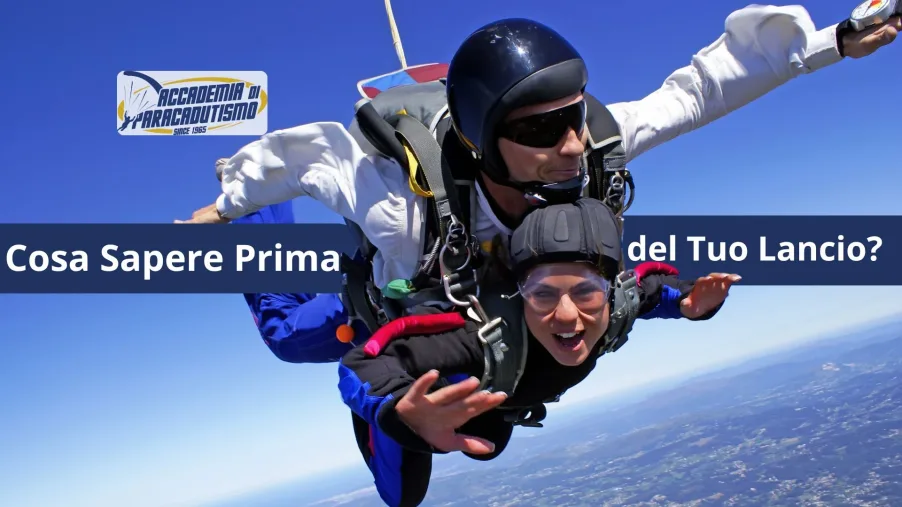
What to Know Before Your Jump
Find out what you need to know before your jump. Your first tandem skydive: adrenaline, safety, epic videos and friends for an unforgettable experience!
Read the article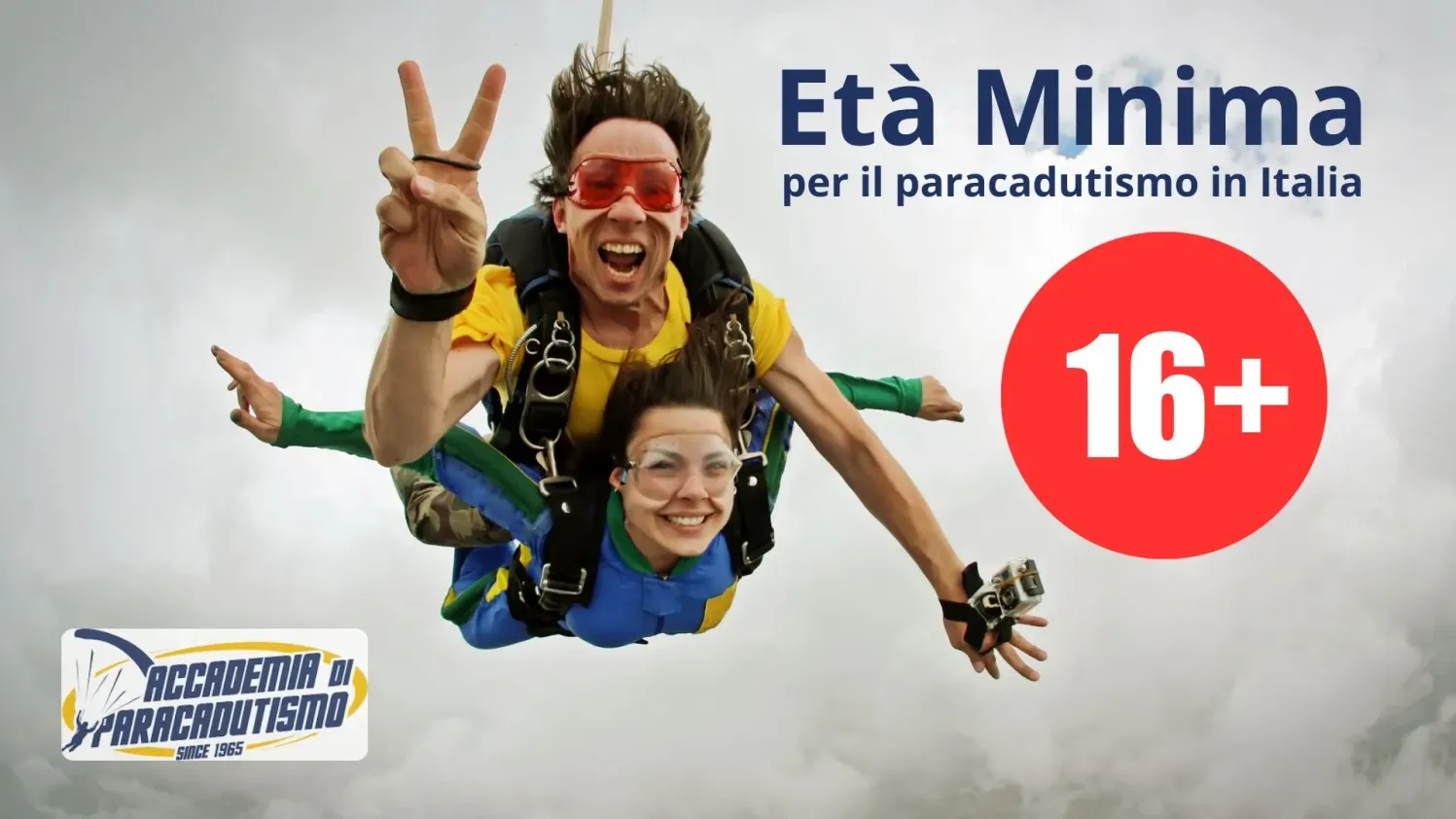
Guides
Minimum Age for Skydiving 2026
The minimum age for skydiving in Italy is 16, with written parental consent required for minors. Safety is a priority: regulations, training and checks have brought fatalities in the US down to 0.46 per 100,000 jumps in 2025 (USPA data).
Read the article
Guides
What does it feel like to jump with a parachute?
A parachute jump is a unique mix of adrenaline and serenity. During freefall, you feel a rush of intense emotions as you reach 200 km/h, but without any sensation of "falling." Once the parachute opens, you move into a moment of peace and contemplation, with breathtaking views and the chance to steer the canopy under your instructor's guidance. It's an experience that combines adventure, freedom, and a deep connection with your surroundings, leaving unforgettable memories.
Read the article