How to Get Your Skydiving License
Updated on September 19, 2026 · 8 min read
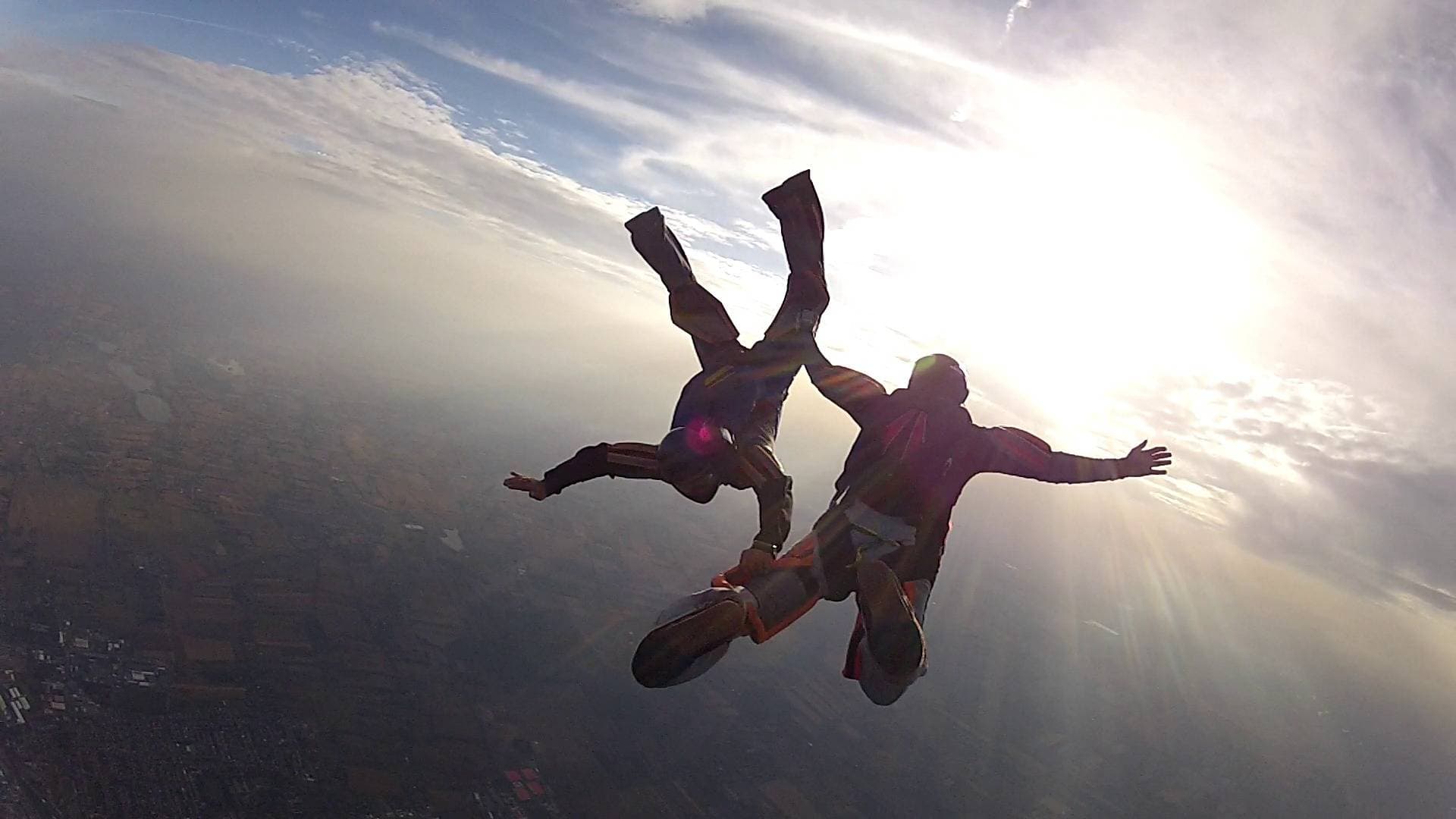
Obtaining a skydiving license in Italy is a process that requires structured training, consisting of theoretical lessons, practical training and passing aptitude tests. This path must be completed at a skydiving school authorised by ENAC (the Italian Civil Aviation Authority).
1. Theoretical training for the skydiving license
Ready to jump? Book your tandem with no advance payment.
Book nowBefore undertaking practical jumps, students must acquire a solid knowledge of the fundamentals of skydiving. Theoretical training includes:
- Parachute aerodynamics: how the parachute behaves in flight, principles of lift and drag.
- Meteorology: interpreting weather conditions for jump safety.
- Structure and operation of the equipment: knowledge of the main parachute, reserve parachute, altimeter and other essential instruments.
- Emergency procedures: managing critical situations, such as a malfunction of the main parachute and use of the reserve parachute.
- Regulations and safety: ENAC regulations for sport skydiving, operational limits and legal obligations.
2. Practical training
Practical training is divided into three phases:
- Preparation on the ground: use of the equipment, freefall posture, aircraft exit techniques and emergency procedures.
- First assisted jumps: with instructors alongside (AFF method), in-flight stability control and management of parachute opening.
- Solo jumps: advanced freefall manoeuvres, landing precision, canopy management and emergency simulations.
The AFF course levels, one by one
In the AFF method the practical part is split into seven levels, each with a jump from 4,200 metres: you start with two instructors beside you and end up jumping alone. Here is what you learn at each level and how much autonomy you have.
| Level | What you learn | Autonomy and support |
|---|---|---|
| Level 1 | Stabilising in flight and monitoring the altimeter | Two instructors; you open the parachute, landing guided by ground radio |
| Levels 2 and 3 | Holding a stable position and first body control manoeuvres | Two instructors; at level 3 they let go of you briefly |
| Levels 4 and 5 | Changes of direction and controlled turns | A single instructor, stepping in less and less |
| Level 6 | Handling the unexpected and recovering stability | One instructor; altitude and opening are down to you |
| Level 7 | A sequence of advanced manoeuvres on the final jump | Full autonomy: you show you can jump on your own |
The full programme, including the 6-7 hours of theory that come first, is described level by level in the article on the 7 levels of the AFF course.
3. Theoretical-practical assessment
Once training is complete, the candidate must sit a theoretical-practical exam to demonstrate the skills acquired. The exam consists of:
- Written or oral test on the theory learned, with questions on aerodynamics, safety, emergency procedures and regulations.
- Assessment of in-flight ability: during the exam jump, the candidate must demonstrate excellent execution of the manoeuvres, showing safe parachute control and correct landing management.
Only after passing both tests can the certification be obtained.
4. Medical fitness certificate
To take part in skydiving courses and obtain the license, you must hold a second-class psycho-physical fitness medical certificate, issued by legal-medical institutes or sports doctors recognised by ENAC.
5. Minimum requirements for issuing the license
How many jumps are needed to obtain a skydiving license? As mentioned above, to obtain the skydiving license you must:
- Minimum age of 16 years
- Complete 50 jumps with a gliding parachute
- Accumulate 20 minutes of freefall
- Pass the theoretical-practical assessment
- Hold a second-class medical certificate
Once obtained, the license has no administrative expiry, but to keep it active you must meet the periodic activity requirements and keep the medical certificate up to date.
What are the requirements to keep the license valid?
The skydiving license has no administrative expiry, but its validity depends on meeting specific activity requirements:
- Minimum periodic activity: at least 15 jumps in the last 12 months, of which at least one in the last three months, and at least 10 minutes of freefall every twelve months.
- Suspended-harness release simulation: must be carried out within the last 12 months.
- Medical certificate: a valid medical examination is required.
How long does it take to get the license?
There is no fixed duration: the AFF course has no rigid dates and fits around your availability. The theory takes 6-7 hours, while the seven jumps can be packed into a few days of good weather or spread across several weekends.
Three things mainly decide how long it takes:
- The weather: strong wind or low cloud stops jumping, and it is by far the biggest variable.
- Your availability: students who can also come on weekdays finish considerably sooner.
- Your own progression: if a level is not passed it is repeated before moving on, which is completely normal.
What happens after you qualify?
Once you pass level 7 you gain the qualification to jump solo: from then on you jump on your own, but the road to the license continues. You still need 50 jumps and 20 accumulated minutes of freefall, plus the theoretical-practical assessment.
In the first months almost everyone keeps renting gear from the school and buys their own later, once they know which canopy suits them and how many jumps they realistically make in a year: the comparison between a new or used parachute helps you work out when it is worth the step.
Where to get a skydiving license?
In Italy there are several authorised skydiving schools where you can take the course to obtain the license. Here are some options, along with the costs of obtaining a skydiving license:
- Accademia di Paracadutismo Casale Monferrato: located in Casale Monferrato, it was among the first schools in Italy to introduce the AFF (Accelerated Free Fall) course, at a cost of around €1,700.
- A.N.P.d'I. Rome Section: the Rome section of the National Association of Italian Paratroopers offers courses that follow the programme of the Pisa Parachutist Training Centre. The course lasts 10 weeks and costs €850.
- Lanciati.it: with locations in Rimini and Ancona, it offers AFF courses with qualified instructors. The course lasts about three days and costs €1,600, and includes registration, seven jumps from 4,200 metres, full equipment rental and the issuing of the parachute jump qualification.
- Paracadutismo Napoli: offers AFF courses with experienced instructors and state-of-the-art equipment. The AFF course costs €1,800, including theory, jumps, experienced instructors, equipment rental and packing.
- SibariFly: located in Calabria, it offers AFF courses with theoretical and practical training. The course includes eight hours of theory and seven jumps from 4,200 metres, with costs covering teaching materials, equipment rental and jump videos.
If you are instead interested in the military route, with static-line jumps and value in public competitive exams, the differences are explained in the article on the military skydiving license.
Become a skydiver with the AFF Course!
Experience the adrenaline of freefall and learn to jump on your own with the Accelerated Free Fall (AFF) method. With experienced instructors and state-of-the-art equipment, our AFF course will guide you step by step until you earn your license. Book your course today!
In conclusion, obtaining a skydiving license is a unique experience that combines adrenaline and technical preparation. If you dream of flying, enrol in the course and make your adventure come true!
If you are already looking beyond the licence, the article on competitive skydiving gives an overview of the sporting disciplines and how you get there.
Frequently asked questions
- How many jumps are needed to get a skydiving license?
- To obtain the license you need at least 50 jumps with a gliding parachute and 20 accumulated minutes of freefall, in addition to being at least 16 years old, passing the theoretical-practical assessment and holding a second-class medical certificate.
- How much does it cost to get a skydiving license?
- The cost of an AFF course generally ranges between €1,600 and €1,800 depending on the school. At the Accademia di Paracadutismo in Casale Monferrato the AFF course costs around €1,700; some A.N.P.d'I. sections offer courses starting from €850.
- What is the minimum age for a skydiving license?
- The minimum age to start the path and obtain a skydiving license is 16. For minors, written parental consent is required.
- What medical certificate do you need for a skydiving course?
- You need a second-class psycho-physical fitness medical certificate, issued by legal-medical institutes or sports doctors recognised by ENAC. It must be kept valid to continue jumping after obtaining the license.
- Does the skydiving license expire?
- The license has no administrative expiry, but to remain valid it requires at least 15 jumps in the last 12 months (one in the last three months), 10 minutes of freefall per year, a suspended-harness release simulation and a valid medical certificate.
- How long does it take to get a skydiving license?
- There is no fixed duration. The theory takes 6-7 hours and the seven AFF jumps can be packed into a few days of good weather or spread over several weekends: it depends on the weather, your availability and how quickly you pass each level.
- How many levels does the AFF course have and what do you learn?
- Seven levels, each with a jump from 4,200 metres. On the first three you fly with two instructors and learn stability and basic control manoeuvres; from the fourth you stay with a single instructor and work on turns and handling the unexpected; on the seventh you show you can jump on your own.
- What is the difference between the solo jump qualification and the skydiving license?
- The qualification comes at the end of the seven AFF levels and lets you jump on your own. The license comes later, once you have accumulated 50 jumps and 20 minutes of freefall and passed the theoretical-practical assessment.
- Do I have to buy a parachute as soon as I qualify?
- No. You can keep renting the school's equipment and buy your own later, when you know which canopy suits you and how many jumps you actually make in a year.
Ready for your tandem jump?
Free, flexible booking with no advance payment. Over 400 five-star reviews.
Useful resources
Keep reading
Guides
Skydiving: EVERYTHING you need to know - Quick 2026 Guide
Skydiving is an adrenaline-filled experience. Choose between a tandem jump or an AFF course to become a solo skydiver. 60 seconds of freefall at 200 km/h, then the parachute opens and the whole world is beneath you. An experience you'll never forget!
Read the article
Guides
What to Know Before Your Jump
Find out what you need to know before your jump. Your first tandem skydive: adrenaline, safety, epic videos and friends for an unforgettable experience!
Read the article
Guides
Minimum Age for Skydiving 2026
The minimum age for skydiving in Italy is 16, with written parental consent required for minors. Safety is a priority: regulations, training and checks have reduced the accident rate to 0.28 per 100,000 jumps.
Read the article