Minimum Age for Skydiving 2026
Updated on September 19, 2026 · 7 min read
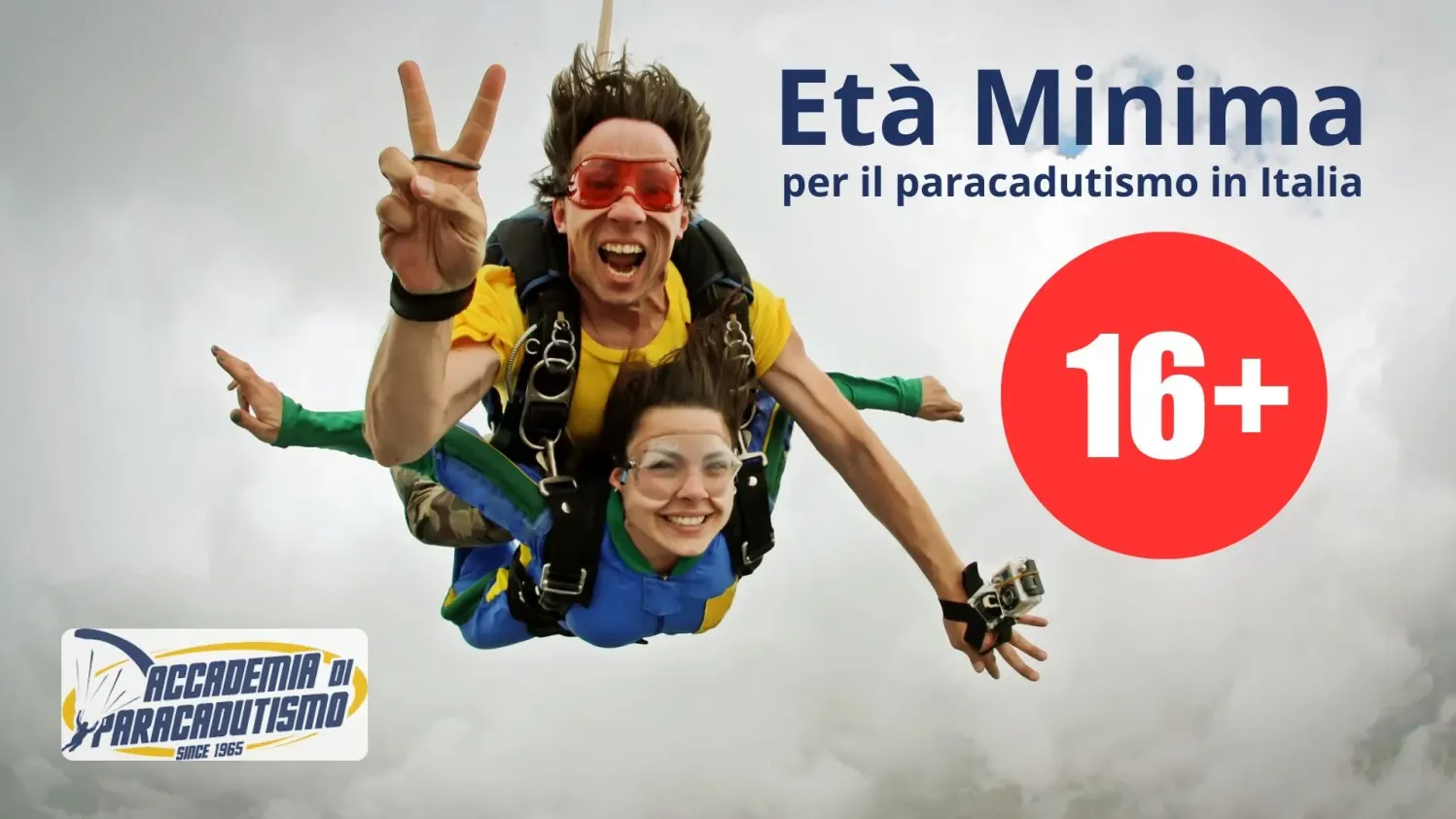
Skydiving is an activity that attracts people of all ages, eager to experience the thrill of flight and free fall. However, there are specific age requirements to take part in this activity in Italy.
Minimum Age for Skydiving in Italy
In Italy, the minimum age to perform a parachute jump is 16.
Ready to jump? Book your tandem with no advance payment.
Book nowThis applies both to tandem jumps, where participants are accompanied by an experienced instructor, and to skydiving courses that lead to independent jumping. For minors, written permission from both parents or legal guardians is required.
Here is a quick summary of what you need in order to jump, age group by age group. If this is your first time, you will find all the practical details on our first jump page.
| Age group | What you need | Type of jump |
|---|---|---|
| 16-17 years old | Written permission from both parents or legal guardians | Tandem jump or course towards solo jumping |
| 18 and over | Good health; some centres ask for a signed health declaration even for tandem jumps | Tandem jump or course towards solo jumping |
| Anyone training for solo jumping, at any age | Medical certificate of fitness issued by a sports doctor or an authorised professional | Solo jump after training |
| Over 60 and beyond | No upper age limit: what counts is physical condition, reporting any medical conditions to the centre | Tandem jump with an instructor |
Minimum Age for Skydiving in Other European Countries
Curious to know what the minimum age is for skydiving in European countries?
The age varies according to the legislation of each European country; let's look at a few:
- France: the minimum age is 15, but written parental consent is required for minors.
- Germany: the minimum age is 14, with parental consent and the supervision of certified instructors required.
- United Kingdom: participants must be at least 16 years old, with parental consent until they are 18.
- Spain: here too the minimum age is 16, but some centres may require additional medical certification for minors.
- Netherlands: the minimum age is 18 for solo jumps, while for tandem jumps participants aged 16 and over are permitted with parental permission.
These differences show that, although skydiving is a regulated activity throughout Europe, each country adopts specific regulations to ensure participant safety and awareness. Furthermore, regardless of the minimum age, all centres require adequate training and compliance with safety regulations.
Why is There an Age Limit?
The age limit in skydiving isn't just a matter of maturity, but a key safety measure: as we explain in our guide on how safe it is to jump with a parachute, every jump relies on standard procedures and redundant systems. Thanks to the introduction of stricter checks, detailed briefings and advanced equipment, accident statistics have plummeted in recent decades.
According to data from the United States Parachute Association (USPA), the fatal accident rate has dropped from 1 in 100,000 jumps in the 1970s to approximately 0.39 per 100,000 jumps in recent years.
Safety as a Top Priority
Safety is the cornerstone of skydiving and permeates every aspect of the activity, from preliminary training to the flight itself. To ensure a safe environment:
- Detailed Instructions: before the jump, each participant receives a detailed briefing explaining the fundamental steps, such as body position during freefall, the right moment to open the parachute and how to manage the landing. Understanding these instructions is crucial to avoid errors that could compromise the safety of both participant and instructor.
- Practical Training: for courses leading to autonomy, participants must complete a training programme that includes emergency simulations and practical tests. Minors, still developing, may not have the same sustained attention span or quick decision-making abilities as adults, further justifying the need for a minimum age limit.
- Constant Supervision: in tandem jumps, the instructor assumes full responsibility for the technical manoeuvres, minimising risks for younger or less experienced participants. This also allows those who are not yet mature enough to experience the activity in complete safety.
- Psychological Requirements: managing anxiety and emotions is another key aspect. Skydiving can be intimidating, and participants must be able to cope with the mental pressure associated with such an intense experience. Minors may find themselves overwhelmed if not properly prepared, which makes the age limit an additional safeguard.
Maximum Age for Skydiving
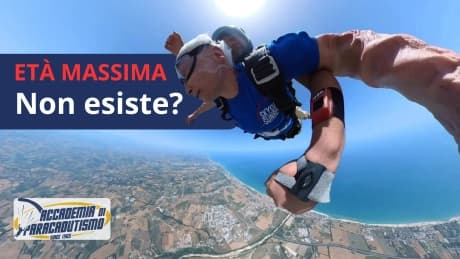
There is no upper age limit for skydiving. Participation depends primarily on the individual's physical condition. People in good health can continue to practise this sport even into old age. For example, the oldest person to make a jump was 101 years old.
Physical and Medical Requirements
In addition to age requirements, it is essential that participants be in good physical health to undertake an activity that can be both physically and mentally challenging.
Medical conditions such as epilepsy, respiratory problems, heart problems or orthopaedic conditions may be contraindications to skydiving, as they may increase the risks during freefall or landing.
For skydiving courses, which involve training and independent jumps, a medical certificate of fitness issued by a sports doctor or authorised professional is required. This certificate ensures that the participant is physically fit to complete all phases of the jump, including any emergencies.
In tandem jumps, where the participant is under the direct supervision of an instructor, the medical certificate requirement is generally less stringent: what you should know and prepare before arriving at the drop zone is summed up in what to know before your tandem jump.
However, it's always advisable to inform the skydiving centre of any current or previous medical conditions to ensure the safety and suitability of the experience. Additionally, some centres may require a signed health declaration, even for tandem jumps.
Parental Consent for Minors
For participants between the ages of 16 and 18, written consent from their parents or legal guardians is required. This ensures that young participants have the support and understanding of their legal guardians regarding the activity they intend to undertake.
In conclusion, skydiving is an activity accessible to anyone aged 16 and over, with parental consent for minors, and without a maximum age limit, provided you are in good health. Before embarking on this adventure, it is advisable to consult local skydiving centres or book your jump directly for detailed information on specific requirements and procedures.
Age is not the only requirement people ask about: the guide to skydiving with a disability explains who can do a tandem jump and which situations should be discussed with the school first.
Frequently asked questions
- What is the minimum age for skydiving in Italy?
- In Italy the minimum age to jump with a parachute is 16, both for tandem jumps and for courses leading to solo jumping. For minors between 16 and 18, written consent from both parents or legal guardians is mandatory.
- Is there a maximum age for jumping?
- No, there is no upper age limit. Participation depends on your physical condition: anyone in good health can jump even at an advanced age. The oldest person to make a jump was 101 years old.
- Do I need a medical certificate to jump?
- For skydiving courses that involve solo jumping, a certificate of sports fitness is required. For tandem jumps the requirement is generally less strict, but it is always advisable to report any medical conditions to the centre.
- Can a 16-year-old start the licence course or only tandem?
- From the age of 16, with parental consent, you can both do a tandem jump and start the training path towards autonomy. The usual medical and safety requirements still apply.
- Is the minimum age the same across Europe?
- No. For example, in Germany it starts at 14, in France at 15, while in the UK, Spain and Italy it is 16. In the Netherlands you need to be 18 for solo jumps and 16 for tandem with parental consent.
- Which medical conditions can prevent a jump?
- Conditions such as epilepsy, respiratory problems, heart disorders or orthopaedic conditions can be contraindications, as they increase the risks during freefall or landing. In these cases a medical assessment is essential.
- Do you need consent from both parents or is one enough?
- For minors between 16 and 18, written permission from both parents or legal guardians is required. From the age of 18 consent is no longer needed and only the health and safety requirements apply.
- Can you gift a jump to someone aged 16 or 17?
- Yes. The gift voucher is valid for 12 months and can be used by anyone who has turned 16: written parental permission is still required on the day of the jump. You can see all the options on the gift page.
- What altitude do you jump from and how long does a tandem jump last?
- The jump is made from 4,200 metres: around 25 minutes of climb, 50-60 seconds of free fall at about 200 km/h, deployment at around 1,500 metres and 5-10 minutes of canopy flight. We look at altitudes in detail in what altitude you skydive from.
Ready for your tandem jump?
Free, flexible booking with no advance payment. Over 400 five-star reviews.
Useful resources
Keep reading

Guides
What does it feel like to jump with a parachute?
A parachute jump is a unique mix of adrenaline and serenity. During freefall, you feel a rush of intense emotions as you reach 200 km/h, but without any sensation of "falling." Once the parachute opens, you move into a moment of peace and contemplation, with breathtaking views and the chance to steer the canopy under your instructor's guidance. It's an experience that combines adventure, freedom, and a deep connection with your surroundings, leaving unforgettable memories.
Read the article
Guides
Casale Monferrato Skydiving Prices 2026
Discover the prices for skydiving in Casale Monferrato in 2026
Read the article
Guides
Skydiving Prices in Italy: The Complete 2026 Guide
The price of a tandem jump ranges on average between €200 and €280, varying by area, school, and number of people.
Read the article