Skydiving with a Disability: Who Can Jump (2026 Guide)
Updated on September 19, 2026 · 7 min read
Can a person with a disability go skydiving?
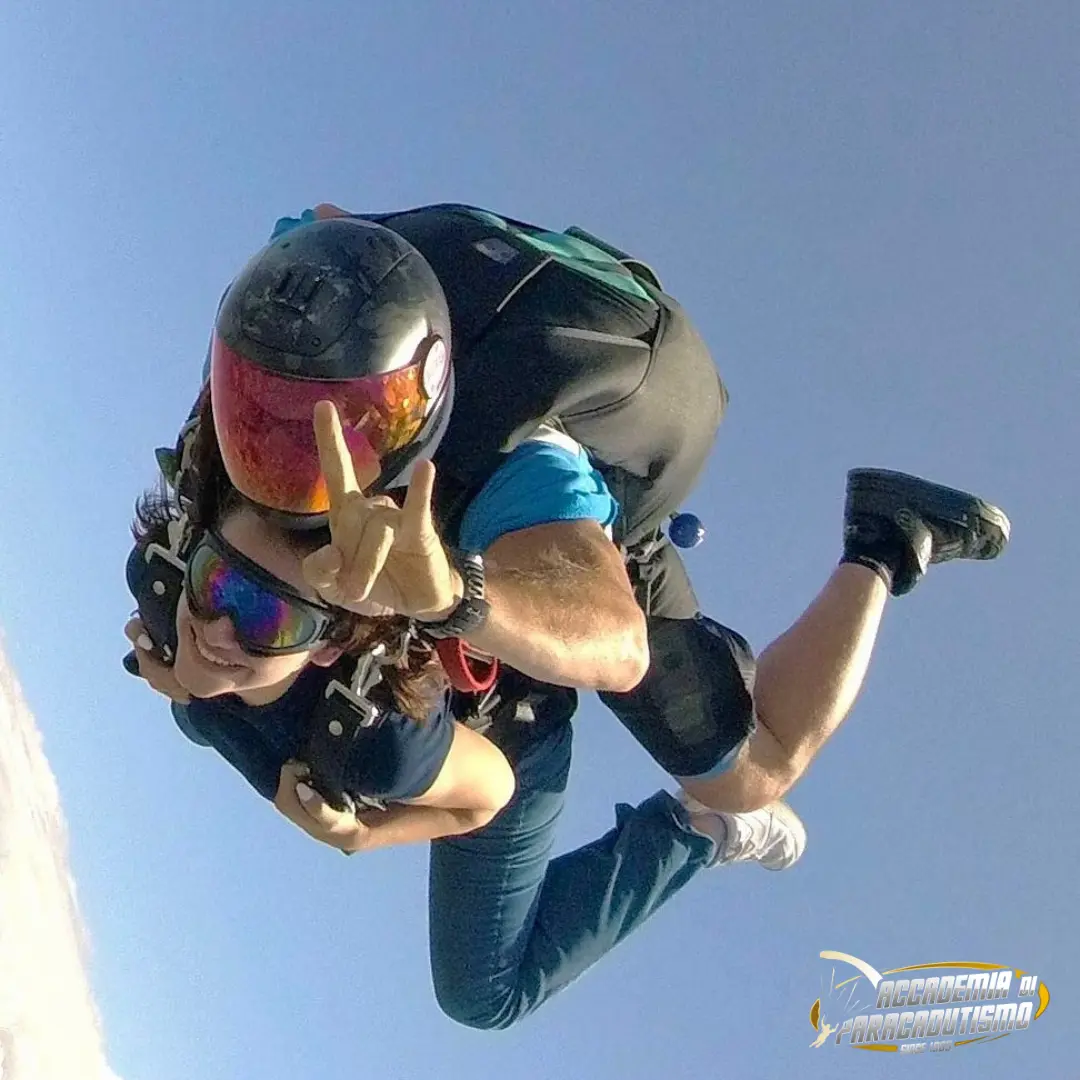
Yes, in many cases a person with a disability can go skydiving, almost always through a tandem jump. The reason is simple: in a tandem you are attached at the front to an instructor who controls the exit from the aircraft, stability in freefall, the parachute deployment and the landing. The passenger does not have to hold technical body positions or perform any maneuvers, and this makes the experience accessible to far more people than you might imagine. Tandem skydiving is, by its very nature, the most inclusive form of this sport: it removes the need for training, specific physical strength or advanced coordination. If you want to understand exactly how the system works, we have a complete guide on what tandem skydiving is and how it works. That said, there are two principles we always repeat:
- Every condition is different. A personalized assessment is essential.
- The final decision rests with the staff and the doctor, who assess the feasibility together with you in complete safety.
Ready to jump? Book your tandem with no advance payment.
Book nowCan you skydive in a wheelchair?
Yes, a tandem jump in a wheelchair is possible: many people with paraplegia or reduced mobility in the lower limbs have gone tandem skydiving, with specific adaptations managed by the instructor. The wheelchair is not needed in the air — the user is assisted during the boarding, exit and landing phases, and body position is managed by the instructor. The aspects we assess together in these cases are:
- Managing the lower limbs during the exit and especially the landing, where dedicated assistance is needed
- The transfer to and from the aircraft
- Any associated medical conditions (for example circulatory problems, spasticity, the presence of medical devices)
This is not something you improvise: it must be organized in advance, by contacting us before booking, so we can prepare the right assistance and let you experience the jump with peace of mind.
Which disabilities are generally compatible with a tandem jump?
Many conditions are compatible with a tandem jump, always subject to assessment. In general, the experience is often accessible to people with:
- Motor disabilities of the lower limbs (with the assistance described above)
- Deafness or hearing loss — communication is agreed before the jump using visual/tactile signals
- Blindness or low vision — the experience is deeply sensory even without sight: wind, acceleration, the silence under canopy
- Amputations — assessing support and landing
- Certain stable, well-controlled chronic conditions
The common element is that, in a tandem, the entire technical load is on the instructor. The passenger's job is to enjoy the experience.
To give a concrete idea of how we proceed, here is a rough outline — every situation is still assessed individually with the staff and, where needed, with a doctor.
| Situation | Usually | What is needed before booking |
|---|---|---|
| Reduced mobility in the lower limbs | Often compatible with a tandem | A preliminary conversation and dedicated assistance for exit and landing |
| Deafness or hearing loss | Often compatible | Visual or tactile signals agreed during the briefing |
| Blindness or low vision | Often compatible | A descriptive briefing and guidance on the ground |
| Amputations | Assessed case by case | Checking support, harness fit and the landing approach |
| An ongoing medical condition | To be assessed with a doctor | A medical opinion and a conversation with the staff before the date |
What are the contraindications to skydiving?
The main contraindications to skydiving concern medical conditions that can be aggravated by pressure changes, exertion or the impact of landing — not disability itself. Here are the situations in which particular caution is required:
- Significant cardiovascular conditions (uncontrolled heart problems, severe hypertension)
- Epilepsy or unstabilized seizure disorders
- Serious inner-ear or respiratory-tract problems
- Recent fractures, severe osteoporosis or significant bone/joint problems
- Pregnancy
- Recent surgery
- Body weight beyond the operating limits of the tandem equipment
- Use of medications that alter balance, consciousness or coagulation
This list is not a diagnosis: it is a map of the situations in which we ask you to talk to your doctor first. If your doubt concerns vertigo, we debunk a myth in our dedicated article on skydiving and vertigo: in freefall, in most cases, it is not felt.
Is a medical certificate required for a tandem jump?
For an introductory tandem jump the regulations are less strict than the path to obtaining a skydiving license. However, in the presence of a disability or specific medical conditions, we always ask for a doctor's opinion, because it is the simplest form of protection for you and it allows us to organize the jump safely. Our approach is the same you would take for any intense sporting activity: no alarmism, just common sense and organization.
How to organize a jump with a disability: the steps
- Contact us before booking, describing your condition as clearly as possible.
- Together we gather the useful information (mobility, medical devices, any medications).
- If necessary, we ask you for a medical opinion regarding your situation.
- We plan the dedicated assistance for boarding, exit and landing.
- We agree on the date, taking into account the weather and allowing for extra time margins.
This preparation is not bureaucracy: it is what turns a "maybe" into a jump experienced with peace of mind. If you are not sure whether your case is one of the feasible ones, the most useful step is simply to write to us and describe your situation: we talk it through with no commitment and tell you honestly what is possible. And if this is your first jump, our first tandem jump guide walks through how the day goes, from the briefing to the landing.
Our experience with inclusivity
In over twenty years of activity at the Casale Monferrato airfield we have taken people with very different stories and conditions up into the sky. What experience has taught us is that tandem skydiving, when organized with care and honesty, is one of the most powerful and liberating experiences there is — precisely because it sets aside the idea of a "limit" and replaces it with that of "possibility". Our commitment is to always tell you the truth: if something is not feasible safely, we tell you clearly. And when it is feasible, we do everything we can to make it a memory you will carry forever.
Frequently asked questions
- Can a person in a wheelchair really jump?
- Yes, in many cases a tandem jump in a wheelchair is possible with dedicated assistance during the boarding, exit and landing phases. It must be organized in advance by contacting the centre.
- Is disability a contraindication to skydiving?
- No, disability in itself is not a contraindication. Contraindications concern specific medical conditions that must be assessed case by case with a doctor.
- Can a blind person do a tandem jump?
- Yes. The skydiving experience is strongly sensory — wind, acceleration, the silence under canopy — and remains intense and engaging even without sight.
- Is a medical certificate required?
- For an introductory tandem it is not always required, but in the presence of a disability or medical conditions we ask for a doctor's opinion to protect the person.
- Who decides whether I can jump?
- The final assessment always rests with the centre's staff, together with your doctor when necessary. That is why it is essential to contact us before booking.
- Can someone come with me and stay for the whole day?
- Yes. Friends and family can stay at the dropzone and watch the jump. If you need any arrangements for moving around on the ground, tell us when you get in touch and we organise them in advance.
- Is there an upper age limit for a tandem jump?
- No, there is no maximum age: the minimum is 16, with parental consent for minors. What we assess is general health, together with you and, when necessary, your doctor.
- How far in advance should a jump with specific needs be organised?
- The more margin, the better. Contact us before booking: we need time to gather the useful information, plan the assistance and choose a date with a backup in case of weather.
Ready for your tandem jump?
Free, flexible booking with no advance payment. Over 400 five-star reviews.
Useful resources
Keep reading
Guides
Tandem Skydiving in Italy: The Complete 2026 Guide
Everything you need to know about tandem skydiving in Italy: what it is, where to jump near Milan, how much it costs, what to wear and how to book your first jump from 4,200 metres.
Read the article
Guides
Skydiving and Vertigo: Can You Jump if You Suffer from Vertigo?
Discover the real relationship between skydiving and vertigo, why it isn't felt in freefall the way it is on the ground, when you can jump without any problems, and what's different from the classic fear of heights.
Read the article
Guides
What to Wear for Skydiving: Complete 2026 Guide
Find out what to wear for skydiving and what to put on for a tandem jump, with practical tips on skydiving clothing, shoes, and the ideal outfit for your first jump in total comfort and safety.
Read the article