Extreme skydiving: disciplines, records and extreme sports in Italy
Published on October 7, 2026 · 10 min read
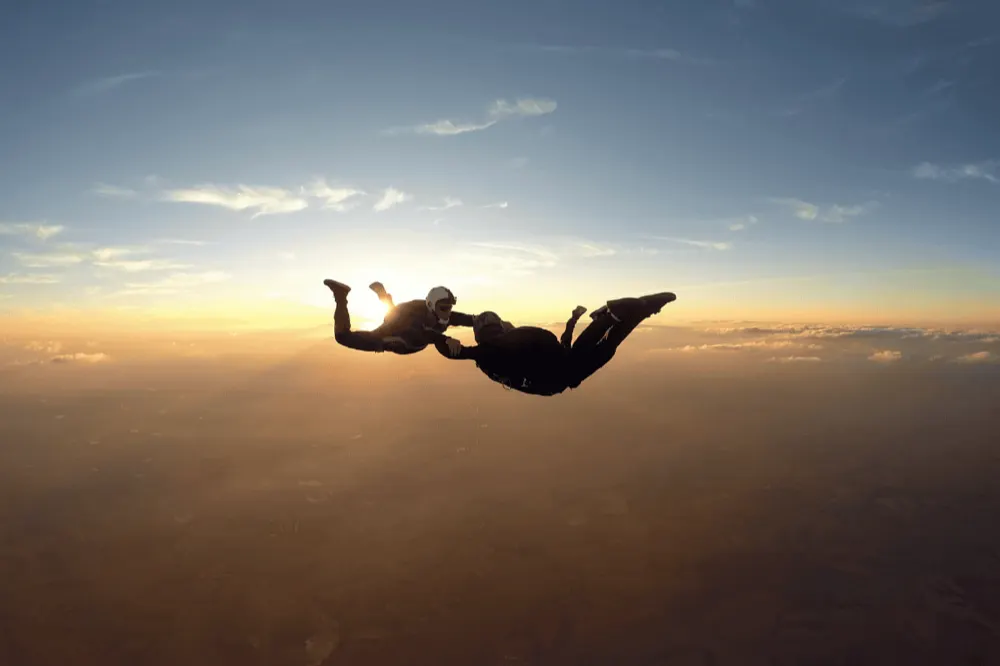
Extreme skydiving usually means the advanced disciplines reserved for jumpers with hundreds of skydives behind them, such as wingsuit flying, freefly, swooping and high-altitude jumps, plus the famous stratospheric records set by Felix Baumgartner (2012) and Alan Eustace (2014). A tandem jump with an instructor is extreme in how it feels, not in how risky it is: you need no experience and the instructor handles all the technical work. The advanced disciplines, on the other hand, are something you build up to step by step.
In short
- "Extreme" can mean two things: intense sensations or high risk. A tandem is the first, not the second.
- The genuinely advanced disciplines are wingsuit, freefly, swooping (canopy piloting) and high-altitude jumps with oxygen.
- BASE jumping is not skydiving: you jump from fixed objects, and studies show a far higher risk.
- The most extreme records are stratospheric: Baumgartner from 38,969 metres in 2012, Eustace from 41,422 metres in 2014.
- The path is always the same: an optional tandem, the AFF course, then a lot of jumps before any specialisation.
Ready to jump? Book your tandem with no advance payment.
Book nowWhat does extreme skydiving actually mean?
Searches for "extreme skydiving" lump together very different things: someone's first tandem jump, freefall speed competitions, wingsuits and leaps from the stratosphere. It helps to separate two meanings of the word.
The first is extreme as an experience: the exit, the freefall, the wind, the altitude. The second is extreme as a level of risk and skill: disciplines where the jumper's own mistakes carry real weight, and which people only take on after years of practice. Tandem belongs to the first group. Wingsuit, swooping and high-altitude jumps belong to the second.
Is a tandem skydive an extreme sport?
In terms of sensations, yes: with us you climb to 4,200 metres, fall freely for about 60 seconds at around 200 km/h, then spend 5-10 minutes under an open canopy. In terms of risk, to be honest, it is a different story. You are attached to a certified instructor who handles the exit, the deployment, any emergency and the landing, and every rig carries a main canopy, a reserve and an automatic activation device.
Zero risk does not exist in any form of aviation, and we will not pretend otherwise. The numbers do show where the risk sits, though. According to the USPA, the United States Parachute Association, its members made 3.47 million jumps in 2025 and there were 16 skydiving fatalities in the US: all types of jump combined, not just tandems. The USPA also notes that many accidents involve experienced skydivers pushing their limits and misjudging the landing under a perfectly good canopy. Put simply, risk grows with the pursuit of performance, not with a first jump.
If you want to understand how the reserve, the automatic device and the instructor work together, it is all explained in how safe skydiving really is.
What are the most extreme skydiving disciplines?
These are the specialities skydivers move on to after getting licensed, once they have built up experience. Here is a quick overview.
| Discipline | What it involves | Why it counts as advanced |
|---|---|---|
| Freefly | Freefall in vertical positions, head-down or sitting, rather than belly to earth | You fall faster and need very precise body control, often close to other jumpers |
| Wingsuit | Flying a suit with fabric wings that turns part of the fall into forward glide | In the US, USPA rules require at least 200 jumps and a current licence |
| Swooping (canopy piloting) | High-speed canopy landings judged on speed, distance and accuracy | Mistakes happen close to the ground, with little margin to correct them |
| HALO and HAHO jumps | High-altitude jumps that originated in the military: low opening (HALO) or high opening (HAHO) | Above certain altitudes you need oxygen and dedicated procedures |
Freefly: falling vertically
In basic skydiving you fall flat, belly to earth. In freefly you also fly upright or head-down, switching orientation during the jump. Speeds are higher and the margin for error is narrower, especially when flying in a group. Freefly is also the root of competitive disciplines such as VFS, covered in our article on competitive skydiving.
Wingsuit: flying with fabric wings
A wingsuit has fabric surfaces between the arms, torso and legs that let you glide forward instead of dropping almost straight down. It is the discipline most people picture when they think of extreme skydiving, and also one of those with the clearest experience rules. The USPA Basic Safety Requirements state that anyone making a wingsuit jump must have at least 200 jumps and a current licence. The USPA also recommends a first-flight course with an experienced coach.
That threshold is not a magic number. In one of its safety articles the USPA explains that by then a jumper's safety habits should have become automatic, leaving mental room for an extra task. Rules vary between countries and dropzones, so anyone aiming for wingsuit flying should check the rules wherever they plan to jump.
Swooping: the thrill is in the landing
In swooping, or canopy piloting, the extreme part is not the freefall but the last few seconds. The pilot flies small, fast canopies and uses a manoeuvre before landing to build speed and skim just above the ground before touching down. It is a recognised competitive discipline, but also the one where a misjudgement costs the most, because it happens close to the ground. People get there after a long, gradual progression in canopy skills.
HALO and HAHO: high-altitude jumps
The acronyms come from the military: HALO stands for high altitude, low opening, and HAHO for high altitude, high opening, with the canopy deployed shortly after exit. Civilian skydiving does include jumps from above normal altitudes, but they require oxygen and specific procedures. USPA rules, for example, make supplementary oxygen on the aircraft mandatory for jumps from above 15,000 feet, about 4,570 metres. Our tandem jumps leave from 4,200 metres, below that line.
Is BASE jumping the same as skydiving?
No, and the difference matters. BASE jumpers leap from fixed objects such as cliffs, bridges or buildings, from far lower heights than an aircraft, with very little time to deal with a problem and the risk of striking the object. It is not a skydiving discipline, and we neither practise nor teach it.
The research is clear. A study at the Kjerag massif in Norway looked at 20,850 jumps and estimated a fatality risk of 0.04% per jump. A more recent study of the Lauterbrunnen valley in Switzerland recorded 39 deaths between 2007 and 2016, with an estimated rate between 0.02% and 0.08% depending on how many jumps are assumed. For comparison, the 2025 USPA figures above work out at fewer than one fatality per 200,000 jumps, while 0.04% at Kjerag is about 40 per 100,000. The data were collected in different ways, so the comparison is only indicative, but the gap is tens of times.
What are the most extreme skydiving records?
The records that defined extreme skydiving are two jumps from the stratosphere, both launched from Roswell, New Mexico.
| Record | Who | When | Figure |
|---|---|---|---|
| Highest freefall speed | Felix Baumgartner | 14 October 2012 | 1,357.6 km/h |
| Exit altitude | Felix Baumgartner (later beaten) | 14 October 2012 | 38,969.4 m |
| Exit altitude, current record | Alan Eustace | 24 October 2014 | 41,422 m |
| Speed skydiving, women (FAI) | Natisha Dingle | 30 August 2025 | 497.31 km/h |
Felix Baumgartner, on the Red Bull Stratos mission, rose in a pressurised capsule beneath a helium balloon and jumped from 38,969.4 metres. According to Guinness World Records he reached 1,357.6 km/h, becoming the first person to break the sound barrier in freefall, and his freefall covered more than 36,000 metres. The speed record is still his.
Alan Eustace, then a Google executive, beat the altitude two years later: according to Guinness he jumped from 41,422 metres, a record verified by the FAI in April 2015. Unlike Baumgartner he used no capsule, rising beneath the balloon in a pressure suit and descending stabilised by a small drogue parachute. He has said he went faster than 1,300 km/h and spent 4 minutes and 27 seconds in freefall.
There is an Italian chapter too. In 2019 Italian skydiver Mascia Ferri set the women's world speed skydiving record at Dunkeswell, England, with 418.25 km/h, as reported by the Italian news agency AGI. The record has since been beaten several times: according to Guinness it now belongs to Australia's Natisha Dingle, at 497.31 km/h.
Which extreme sports can you try in Italy?
If you are looking for extreme sports in Italy beyond skydiving, a few activities have well-known locations. A short overview:
- Bungee jumping at Veglio (Biella): you jump from the Pistolesa bridge, nicknamed Colossus, 152 metres high. How it compares with a parachute jump is covered in skydiving or bungee jumping.
- Volo dell'Angelo in Basilicata: two steel cables between the villages of Castelmezzano and Pietrapertosa, in the Lucanian Dolomites, each over 1,400 metres long, with top speeds quoted at up to 120 km/h.
- Rafting in Valsesia: on the Sesia river in Piedmont, around Balmuccia, Muro and Isola di Vocca, where Italy's first rafting centre opened in 1978.
- Canyoning in Val Bodengo: at Gordona, in the province of Sondrio, along the Boggia stream, with guided routes of increasing difficulty.
- Skydiving at Casale Monferrato: our centre at Francesco Cappa Airport, with tandem jumps from 4,200 metres and the AFF course.
The same rule applies to all of them: go with professional operators and always ask how they manage safety.
How do you get into advanced disciplines?
Nobody starts with a wingsuit or with swooping. The usual path looks like this:
- A tandem jump, if you want one. It is not required, but it is the easiest way to find out whether skydiving is for you. How the day works is explained in your first tandem jump.
- The AFF course. A day of theory and 7 practical levels in which you learn to handle freefall, deployment and landing yourself, with instructors alongside you in the early levels. Programme and requirements are on the AFF course page.
- Jumps and experience. After you are licensed you keep jumping: stability, flying with others, canopy skills. This is the longest phase, and the one that builds safe habits.
- Specialisation. Only then do you choose a discipline, with dedicated courses and coaches. Requirements depend on the country and the dropzone: for wingsuit the USPA asks for 200 jumps, and for other disciplines you should ask the instructors where you jump.
A tandem is a complete experience in its own right: it does not commit you to the course, and plenty of people do it once and leave it there. With us it costs €180 on weekdays and €200 at weekends and on public holidays, booking is free and you pay on the day: details are on the prices page.
Frequently asked questions
- Who holds the record for the highest parachute jump?
- Alan Eustace, who jumped from 41,422 metres above Roswell, New Mexico, on 24 October 2014. The freefall speed record, 1,357.6 km/h, still belongs to Felix Baumgartner, set in 2012.
- Do you need to be an athlete to do a skydive?
- Not for a tandem: you need to be at least 16 (with parental consent if under 18), weigh no more than 100 kg and be in good health. The AFF course also requires a sports medical check.
- Can I take the AFF course without doing a tandem first?
- Yes. A tandem is not a requirement for the AFF course. It is simply a good way to find out whether you enjoy skydiving before starting a training path.
- Is extreme skydiving an official discipline?
- No. It is an informal label usually applied to advanced disciplines such as wingsuit, freefly and swooping, and to record jumps from the stratosphere.
- Do you need oxygen on a tandem jump?
- No. Our tandem jumps leave from 4,200 metres and you breathe normally throughout. Oxygen comes into play on higher jumps: USPA rules, for example, make it mandatory on board above 15,000 feet, about 4,570 metres.
Ready for your tandem jump?
Free, flexible booking with no advance payment. Over 400 five-star reviews.
Useful resources
Keep reading
Guides
Skydiving statistics: safety, jumps and participation figures (updated for 2026)
The official numbers on skydiving safety: fatalities per 100,000 jumps in the US from 2005 to 2025, tandem, injuries, a country comparison and what is actually known about Italy.
Read the article
Guides
Celebrities who went skydiving: 10 true stories
From George H. W. Bush to Tom Cruise, from King Charles to Italian TV stars: who really jumped with a parachute, when, and what kind of jump it was.
Read the article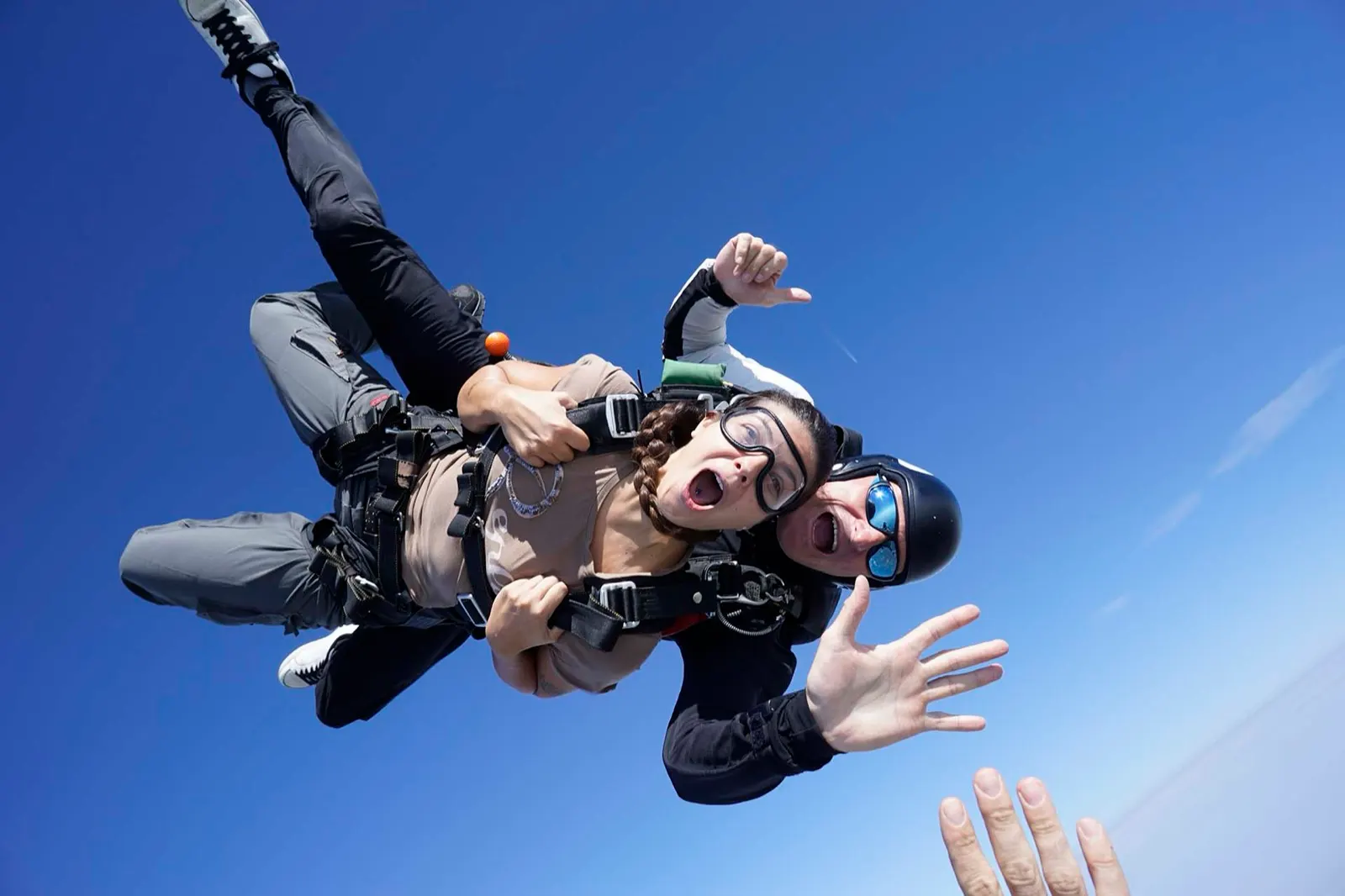
Guides
What altitude do you skydive from (and why it matters)
Jump altitude varies from one Italian dropzone to another: we go up to 4,200 metres, for around 50-60 seconds of freefall.
Read the article