
Skydiving statistics: safety, jumps and participation figures (updated for 2026)
Published on October 7, 2026 · 8 min read
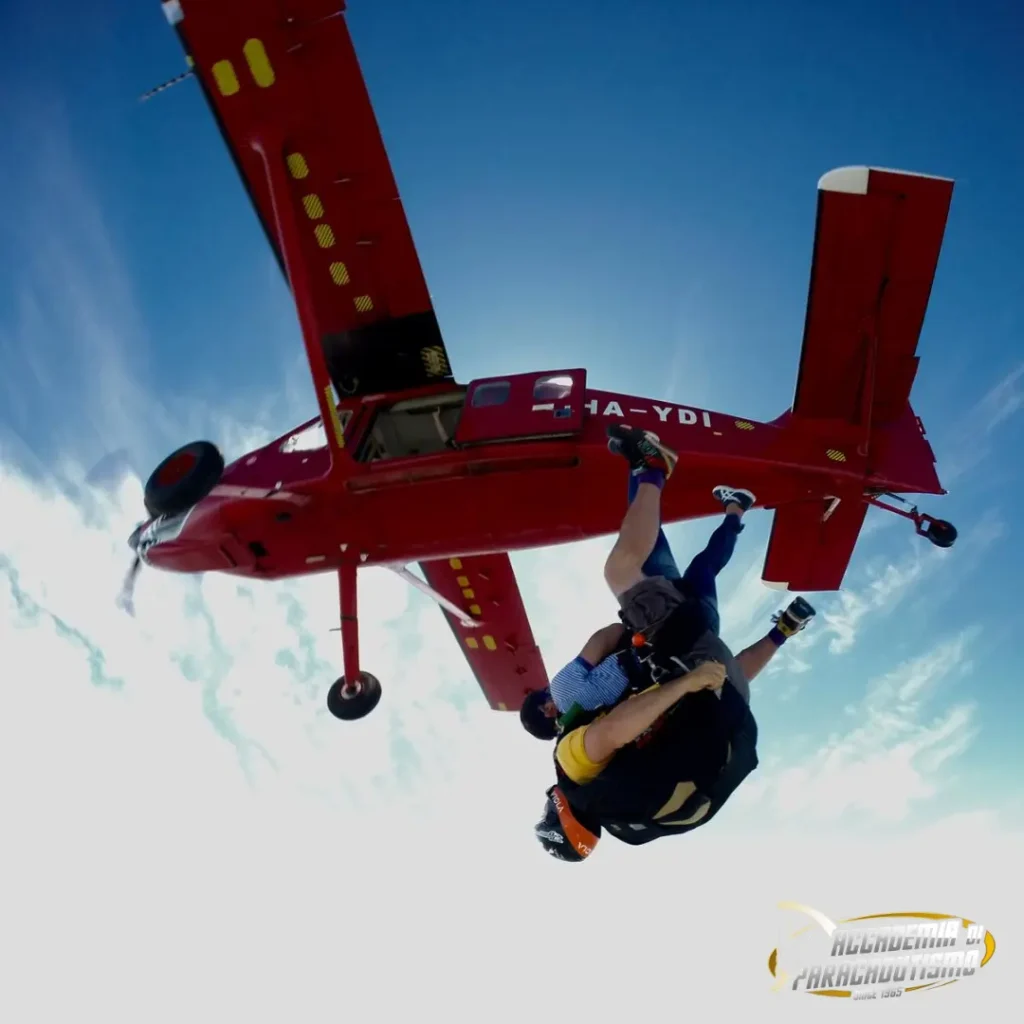
According to the USPA, the United States Parachute Association, the US recorded 16 skydiving fatalities out of about 3.47 million jumps in 2025: 0.46 per 100,000 jumps, or roughly one in 217,000. 2024 was the safest year on record, at 0.23 per 100,000. Italy has no official public fatality statistic, but in 2026 the Italian Civil Aviation Authority (ENAC) presented its incident reporting data for 2024 and 2025, which you will find below.
This page only uses figures with a verifiable source, always with the year they refer to. Where data does not exist, we say so.
Key points
Ready to jump? Book your tandem with no advance payment.
Book now- US 2025: 16 fatalities out of 3.47 million jumps, 0.46 per 100,000 (USPA). In 2024 there were 9 out of 3.88 million, the lowest since records began in 1961.
- In 1961 the rate was around 11 fatalities per 100,000 jumps: more than twenty times today's figure.
- Tandem: in the US there was one fatal tandem accident in 2024 and one in 2025; in 2025 no student died, only the second time since 1961.
- Causes: most accidents come down to human error, very often on landing under a perfectly good canopy.
- Italy: no official public fatality rate. ENAC logged 20 reports in 2024 and 30 in 2025, about 2 events per 10,000 jumps.
How many people die skydiving each year?
The most complete source is the USPA, which each year compares two figures: civilian skydiving deaths in the US and the number of jumps estimated from its member survey. Dividing one by the other gives an index, fatalities per 100,000 jumps, which lets you compare years with very different activity levels.
In 2025 the index was 0.46, against 0.23 in 2024. The USPA points out that in 1961, the first year of its records, the figure was around 11: a skydiver back then was about 22 times more likely to die on a jump than one today. 2025 was a step back from the record year, and it is fair to say so, but it is in line with the average of the last decade.
How has the fatality rate changed from 2005 to 2025?
These are the figures published by the USPA on its safety page. Jump totals are estimates based on the annual member survey.
| Year | US fatalities | Estimated jumps | Fatalities per 100,000 jumps |
|---|---|---|---|
| 2005 | 27 | 2.6 million | 1.04 |
| 2008 | 30 | 2.6 million | 1.15 |
| 2010 | 21 | 3.0 million | 0.70 |
| 2015 | 21 | 3.5 million | 0.60 |
| 2017 | 24 | 3.2 million | 0.75 |
| 2018 | 13 | 3.3 million | 0.39 |
| 2019 | 15 | 3.3 million | 0.45 |
| 2020 | 11 | 2.8 million | 0.39 |
| 2021 | 10 | 3.57 million | 0.28 |
| 2022 | 20 | 3.9 million | 0.51 |
| 2023 | 10 | 3.65 million | 0.27 |
| 2024 | 9 | 3.88 million | 0.23 |
| 2025 | 16 | 3.47 million | 0.46 |
The long-term trend is clear: twenty years ago the rate was often above 1, and since 2018 it has stayed below 0.52. But the absolute numbers are small, so a handful of accidents either way is enough to move the index noticeably, as happened between 2024 and 2025.
What is the tandem skydiving fatality rate?
The USPA's official table does not give a separate rate for tandem jumps. A figure of "one death per 500,000 tandem jumps" circulates widely online, but we could not trace it back to a current official document, so we do not use it. What we can do is read the USPA's annual fatality summaries, which describe every single accident.
| Year (US) | Fatal tandem accidents | Cause according to the USPA |
|---|---|---|
| 2022 | 4 | Safety rules broken by the instructor (low turns on landing, deploying below the minimum altitude) |
| 2023 | 0 | No fatal tandem accidents |
| 2024 | 1 | Sudden turbulence close to the ground |
| 2025 | 1 | Entanglement with the aircraft on exit; the student survived |
One point stands out: in the cases the USPA describes, the problem was not a parachute failing to open but procedures not being followed. USPA rules, for example, require tandem instructors to start deployment no lower than 5,000 feet, about 1,500 metres: the altitude we cover in our guide on what altitude you jump from.
Why do skydiving accidents happen?
The USPA is explicit: many people assume equipment failure is the main cause, but the vast majority of accidents involve human error. Often it is an experienced skydiver misjudging the landing under a perfectly functioning canopy. This is how the 16 US fatalities of 2025 break down.
| Cause (US 2025) | Fatalities | Share 2006-2025 |
|---|---|---|
| Landing problems | 4 | 34.4% |
| No main or reserve deployment | 3 | 4.9% |
| Canopy collision | 2 | 11.7% |
| Freefall collision | 2 | 2.7% |
| Equipment problem | 2 | 12.5% |
| Medical | 2 | 10.3% |
| Aircraft entanglement | 1 | 0.3% |
Of the four landing fatalities, three were intentional low turns made to build speed and one an unplanned low turn: in the cases described, these were jumpers with hundreds or thousands of jumps flying small, fast canopies.
How many skydivers are there, and how many jumps are made?
- United States: the USPA reports more than 41,000 members, roughly 3.6 million jumps a year and almost 200 affiliated drop zones. Its all-time membership high was 42,281, in June 2022.
- Who jumps: in 2024, 85% of USPA members were men and 14% women.
How common are injuries and reserve rides?
Fatalities are only part of the picture. In the USPA survey for 2025, 5.6% of members reported at least one injury that needed medical treatment, mostly ankles on landing. 11.8% used their reserve at least once, for an estimated 4,777 reserve rides: on average one every 726 jumps. We explain what happens at that moment in what happens if your parachute doesn't open.
A systematic review published in 2023 in an international public health journal, covering more than 62 million jumps from studies and from the US, British and German associations, found an average injury rate of 0.044% and a fatality rate of 0.0011% per jump. The authors conclude that with modern equipment and training, fatalities stay below 1 per 100,000 jumps and serious injuries needing hospital care below 2 per 10,000.
Country comparison: US, UK, Germany and Italy
Each association collects data in its own way, so comparisons need caution. The table always shows source and period.
| Country | Source | Figure | Period |
|---|---|---|---|
| United States | USPA | 0.46 fatalities per 100,000 jumps | 2025 |
| United States | USPA | 0.23 fatalities per 100,000 jumps (record low) | 2024 |
| United Kingdom | BPA, as compiled in the 2023 review | about 0.6 per 100,000 on average; 0.3 in 2017 | data up to 2018 |
| Germany | DFV, same review | about 1.5 per 100,000 on average; 0.5 in 2017 | data up to 2018 |
| Italy | ENAC | no public fatality rate; 2.15 reported events per 10,000 jumps | 2025 |
For the UK, the same review also lists injuries reported to the BPA: 144 out of 303,882 jumps in 2018, about 0.05%. We were unable to access more recent BPA reports with complete annual figures.
What about Italy? What is actually known
We searched the publications of ENAC and the Aero Club d'Italia: there is no public national statistic on the number of skydivers, annual jumps or fatalities.
The most concrete Italian data comes from ENAC, which collects reports of accidents and incidents through a reporting system dedicated to skydiving. At a workshop with Italian schools on 18 March 2026, an ENAC investigator presented these figures.
| ENAC reports | 2024 | 2025 |
|---|---|---|
| Accident (most serious category) | 8 | 13 |
| Serious incident | 7 | 7 |
| Incident | 5 | 10 |
| Total | 20 | 30 |
| Events per 10,000 jumps | 1.79 | 2.15 |
Two caveats. First, "accident" does not mean fatality, and the slides do not say how many events were fatal. Second, ENAC attributes much of the 2025 increase to more reporting of minor events and near misses, although for accidents it speaks of a real increase.
In 2024 the rate was 2.03 events per 10,000 jumps for unlicensed students and 0.95 for licensed skydivers. Over the two years, events cluster among jumpers with fewer than 50 jumps (16 cases) and those with more than 1,000 (13), with very few in between: ENAC calls it the "U-curve of experience".
How to read these numbers before your first jump
General statistics lump together every kind of jump: students, tandems, experienced skydivers doing high-speed landings, wingsuits. Many of the most frequent causes involve canopy-piloting decisions that, on a tandem, are made by the instructor rather than by you. That is why an overall average does not, on its own, describe the risk of a single tandem jump.
To see how the safety layers of a jump actually work, read how safe is skydiving. If you are thinking about your first jump, the first time page covers requirements, how the day runs and prices, and you can book with no advance payment.
Frequently asked questions
- What are the odds of dying while skydiving?
- According to the USPA, in 2025 there was about one fatality every 217,000 jumps in the US (16 out of 3.47 million). In 2024 it was one every 431,111 jumps. These are averages across every type of jump, not just tandem.
- Is skydiving riskier for beginners?
- It depends on what you measure. In Italy, ENAC recorded 2.03 reported events per 10,000 jumps for students in 2024 and 0.95 for licensed skydivers. In the US, on the other hand, no student died in 2025, and most fatalities involve experienced jumpers.
- How often does a skydiver use the reserve parachute?
- In the USPA survey for 2025, members reported an estimated 4,777 reserve rides, on average one every 726 jumps. Using the reserve is a planned, trained procedure, and in the vast majority of cases the jump ends with a normal landing.
- How many skydivers are there in Italy?
- There is no official public figure. ENAC issues skydiving licences but does not publish the number of active licences or annual jumps.
- Are skydiving aircraft safe?
- The USPA says skydiving operations have a much lower aircraft accident rate than general aviation. In the US, between 2016 and 2025 there were nine fatal skydiving-related aircraft accidents, with 26 fatalities in total.
Ready for your tandem jump?
Free, flexible booking with no advance payment. Over 400 five-star reviews.
Useful resources
Keep reading
Guides
Celebrities who went skydiving: 10 true stories
From George H. W. Bush to Tom Cruise, from King Charles to Italian TV stars: who really jumped with a parachute, when, and what kind of jump it was.
Read the article
Guides
What altitude do you skydive from (and why it matters)
Jump altitude varies from one Italian dropzone to another: we go up to 4,200 metres, for around 50-60 seconds of freefall.
Read the article
Guides
Skydiving freefall: how long it lasts and how fast you go
From 4,200 metres freefall lasts around 50-60 seconds at about 200 km/h: every number of the jump, phase by phase.
Read the article