What happens if your parachute doesn't open?
Published on October 7, 2026 · 11 min read
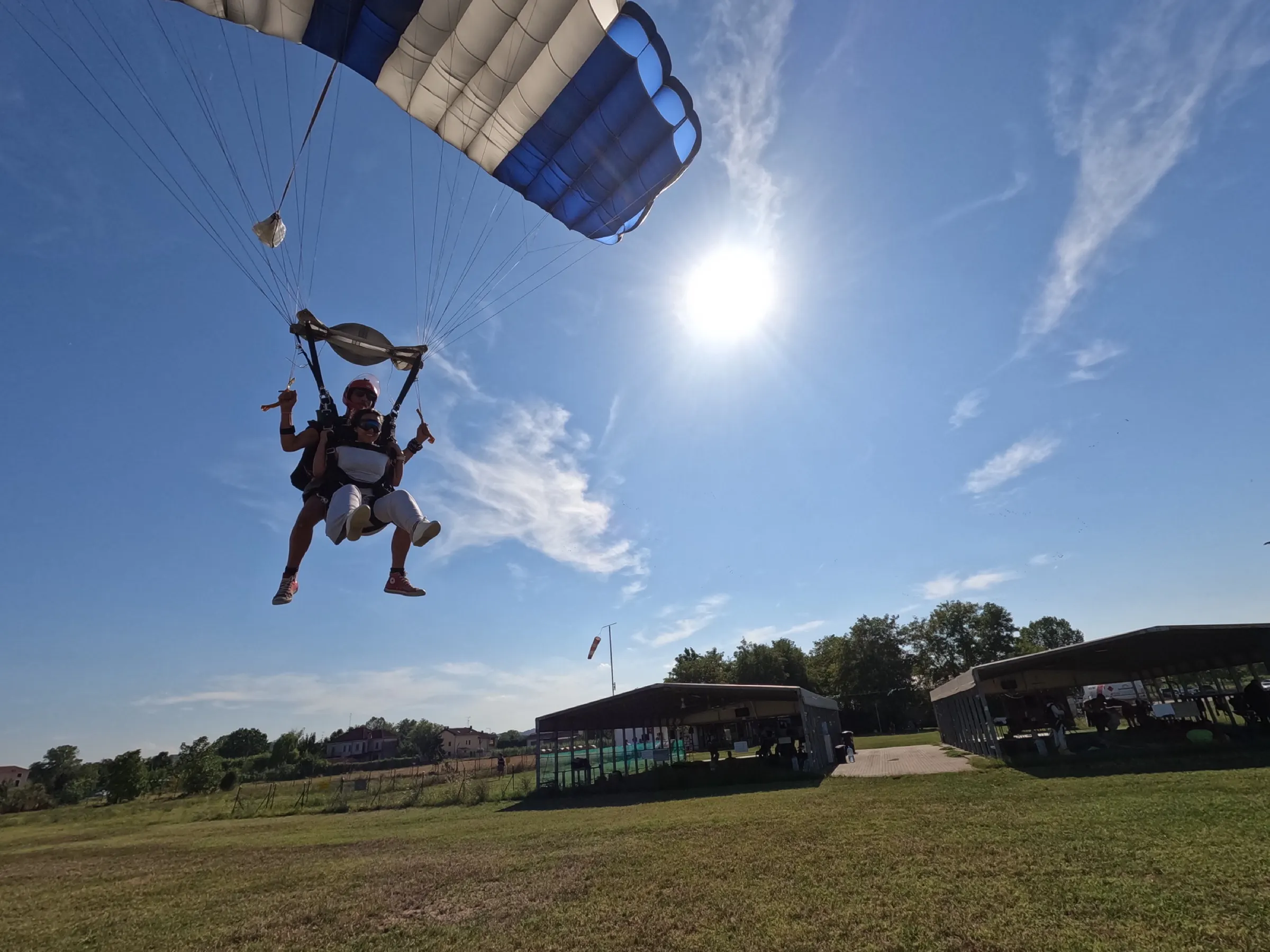
If your main parachute doesn't open, or opens badly, the second one does. Every skydiving system carries two independent parachutes: the main canopy and the reserve. Whoever is flying the system (on a tandem, your instructor) cuts away the main and opens the reserve; and if for any reason nobody does, an automatic activation device, the AAD, opens the reserve on its own below a safe altitude. Zero risk doesn't exist, and we won't pretend it does: the whole system is built so that one problem on its own isn't enough to cause an accident.
If you're thinking about your first tandem skydive and this question keeps you up at night, you're in good company: it's the one we hear most. Here's how it really works, with official figures and no sugar-coating.
Key points
Ready to jump? Book your tandem with no advance payment.
Book now- Every rig has two independent parachutes: the main and the reserve, packed in separate compartments.
- Malfunctions do happen, and the person flying the rig is trained to spot them: the standard response is to cut away the main and open the reserve.
- The AAD (CYPRES or Vigil, for example) tracks altitude and speed and, in its tandem setting, fires the reserve by itself if you're still falling at freefall speed below roughly 600 metres (about 2,000 ft).
- Only a certificated rigger may pack the reserve; in the US the FAA requires it to be repacked at least every 180 days.
- On a tandem you don't have to do anything technical: opening the canopy and handling any emergency is the instructor's job.
How a skydiving rig works: two canopies, not one
The container your instructor wears on their back, the one you're clipped to, holds two separate parachutes, each in its own compartment and each with its own handle. The main canopy is used on every jump: it opens at altitude and flies you both down to landing. The reserve is the emergency parachute: it stays closed and is only used if something goes wrong with the main. A problem with the main doesn't affect the reserve, which is packed by a different person under stricter rules.
Tandem rigs add one more piece, the drogue: a small stabilising parachute the instructor throws out right after exit. It slows the pair down and keeps you stable in freefall, and when it's time to open, it's used to pull out the main canopy.
| Component | What it does | Who handles it |
|---|---|---|
| Drogue | Slows and stabilises the pair in freefall, then extracts the main | Instructor |
| Main canopy | Opens at altitude (around 1,500 m with us) and flies you to the ground | Instructor |
| Reserve canopy | Emergency parachute, independent of the main | Instructor, or the AAD automatically |
| AAD | Tracks altitude and speed and opens the reserve if nobody else does | Works by itself once switched on at ground level |
What is a parachute malfunction?
A malfunction is any opening that doesn't give you a healthy, steerable canopy. The word sounds terrifying, but most of the time it doesn't mean "nothing comes out": it means the canopy came out imperfectly and someone has to decide whether it can be flown or needs replacing with the reserve.
The USPA, the United States Parachute Association, splits them into two broad groups in its training manual:
- Total malfunction: the container stays closed and the canopy never comes out. One example is a *pilot chute in tow*, where the small chute that pulls the canopy out inflates but can't drag the bag free.
- Partial malfunction: the canopy comes out but isn't landable. For example, a line passes over the top and splits it in two (a *line-over*), or the canopy stays trapped in its deployment bag (a *bag lock*).
Then there are smaller, more common issues such as line twists: the canopy is open, but the lines are twisted around each other. The person flying checks within moments whether the canopy is controllable: if it is, the jump carries on; if not, it's time for the emergency procedure.
How often does this happen? More often than most people think, and you deserve to know that. In the USPA's annual member survey for 2025, 11.8% of members reported using their reserve, for an estimated 4,777 reserve rides: on average one every 726 jumps. That figure covers all sport skydivers, many of them flying small, fast canopies, not just tandems. And here's the other half of the story: in the same year there were 16 fatalities from all causes. In other words, the vast majority of reserve rides end with a perfectly ordinary landing.
What happens if the main doesn't open: the emergency procedure
The procedure is always the same, and skydivers rehearse it on the ground until it's automatic.
- Canopy check. Right after opening, you look up: the canopy should be open, intact and steerable.
- Decision. If there's a problem that can't be fixed, the call is made by a set altitude. For students, the USPA puts that decision altitude at no lower than 2,500 ft (about 760 m).
- Cutaway. Pulling the cutaway handle releases the main completely from the harness. This happens before the reserve is opened, so the two canopies can't tangle.
- Reserve. Pulling the reserve handle releases the reserve from its compartment and it opens. Many rigs, and in the US all student rigs by rule, also have a lanyard (the RSL) that fires the reserve as soon as the main is cut away.
- Flying the reserve. From there you fly and land as you would under any other canopy.
There's also a floor below which you no longer cut away: the USPA sets a 1,000 ft hard deck, about 300 m. Below that, with a main that's only partly open, you deploy the reserve without cutting away.
On a tandem jump the main opens at around 1,500 metres, well above these altitudes, which gives the instructor room to check the canopy calmly and, if needed, run through the procedure.
The automatic activation device (AAD): how it works
An AAD is a small computer mounted inside the container. The best-known models are CYPRES and Vigil. It's switched on at ground level, where it calibrates to the air pressure at the airfield; during the jump it keeps measuring barometric pressure and works out altitude and rate of descent from it.
If it senses that you're still falling at freefall speed below a set altitude, it fires a small cutter that slices the loop holding the reserve compartment closed. The reserve springs out and opens, without anyone pulling anything.
The thresholds depend on the model and mode. For tandem use, according to the manufacturers:
| Device | Fires below roughly | If descent speed is at least |
|---|---|---|
| CYPRES 2 Tandem | 580 m (1,900 ft) | 35 m/s (78 mph) |
| Vigil, TANDEM mode | 622 m (2,040 ft) | 35 m/s (78 mph) |
CYPRES explains that the tandem altitude is higher than on expert models because tandem canopies are bigger and need more room to open. Under an open canopy you descend far slower than 35 m/s, so the AAD stays out of the way on a normal jump: it exists for the worst case, a freefall that carries on too low, for whatever reason.
It isn't infallible and it doesn't replace the person flying: it's the last safety net. In its 2025 fatality summary, the USPA describes cases where the device fired too late, in unusual situations such as a wingsuiter in a spin, and cases where the jumper simply didn't have one. The same report stresses that AADs and RSLs improve the odds of a reserve deploying when it's needed. For tandem rigs in the US, federal FAA rules make the AAD mandatory: it must be approved by the rig manufacturer, maintained to its instructions and switched on for every jump.
Who packs the reserve parachute, and how often?
The main canopy can be packed by the skydiver or by trained packers. The reserve can't: only a certificated parachute rigger may pack it. That's one of the reasons the two canopies are treated as separate systems.
In the US this is written into FAA regulations: a reserve made of nylon or other synthetic materials must have been packed by a certificated rigger within the previous 180 days, even if it hasn't been used in the meantime. If it contains natural fibres such as silk, the limit drops to 60 days.
We don't quote a figure for Italy, because we couldn't find it in an official source we could check. If you're curious, ask your instructor on the day: it's a fair question, and answering it is part of the job.
On a tandem jump, who does what?
The answer is simple: everything to do with the parachute is the instructor's job. You don't open anything, you don't have to recognise a malfunction and you don't pull any handles.
| Phase | Your instructor | You |
|---|---|---|
| Ground briefing | Explains the body positions and checks the gear | Listen and ask anything you like |
| Exit and freefall | Throws the drogue, watches altitude and stability | Hold the position from the briefing |
| Opening, around 1,500 m | Opens the main and checks it | Nothing technical to do |
| Any emergency | Cuts away the main and opens the reserve | Nothing technical: stay put and follow their instructions |
| Canopy flight and landing | Flies the canopy to the ground | Hold the landing position from the briefing |
Tandem instructors are experienced skydivers with a dedicated rating. In the US, for instance, the FAA requires at least three years in the sport, a master parachute licence and a course run by the manufacturer of the tandem system being used. Our instructors are certified and have thousands of jumps behind them.
How likely is it, in numbers?
The most solid figures come from the USPA, which publishes a summary of US skydiving fatalities every year alongside the number of jumps made.
| Year | Jumps | Fatalities | Per 100,000 jumps |
|---|---|---|---|
| 2024 | 3.88 million | 9 | 0.23 |
| 2025 | 3.47 million | 16 | 0.46 |
2024 was the safest year since the USPA started keeping records in 1961: roughly one fatality every 430,000 jumps. 2025 was worse, and it's only fair to say so: the numbers move from year to year. For comparison, the 1961 rate was around 11 per 100,000 jumps. The full series, year by year, is in our skydiving statistics; how the safety systems of every jump work is explained in how safe skydiving is.
Two details matter if your specific fear is the parachute not opening. First, in 2024 the most common cause was landing (4 of the 9 cases), not a canopy failing to open. Second, tandems: in both 2024 and 2025 the USPA recorded a single fatal tandem accident per year, and in neither case was the cause a parachute that didn't open.
Dealing with the fear before you jump
Knowing how it all works won't make the fear vanish, but it gives it something concrete to hold on to. A few practical tips:
- Ask your questions during the briefing, even the ones that feel silly. "What if it doesn't open?" is the most common of all, and nobody will be surprised.
- Remember you have one job: hold the position you were shown. Everything else is not on you.
- If it's the height that scares you more than the parachute, read our guide on overcoming the fear of heights, vertigo and acrophobia.
To see how the whole day goes, from gearing up to landing, every step is on our first tandem jump page. When you feel ready, you can book without paying anything upfront. And if after your tandem you'd like to learn to handle these procedures yourself, there's the AFF course: an option, not a requirement.
Frequently asked questions
- Can the reserve parachute fail too?
- No parachute is infallible, and it's right to say so. The reserve, though, is treated differently from the main: only a certificated rigger may pack it, on a fixed schedule, and it stays closed in its own compartment until it's needed. On top of that, the AAD can open it by itself if nobody else does.
- What if the instructor passed out during freefall?
- That's exactly what the AAD is for. If the pair is still falling at freefall speed below its activation altitude, the device opens the reserve by itself. On the tandem versions of CYPRES and Vigil that altitude is around 600 metres (about 2,000 ft).
- Is an automatic activation device mandatory?
- In the US, yes, on tandem rigs (an FAA rule) and on student rigs (a USPA rule). According to the USPA, at least 90% of experienced skydivers also use one.
- Do I need experience or a course to do a tandem skydive?
- No. On a tandem you're attached to a certified instructor who handles everything. You need to be at least 16 (with written consent from your parents if you're under 18), weigh no more than 100 kg and be in good health. No medical certificate is required.
- How long is the freefall before the parachute opens?
- From 4,200 metres, freefall lasts around 50-60 seconds at roughly 200 km/h. The instructor opens the main at about 1,500 metres, followed by 5-10 minutes under canopy until landing.
Ready for your tandem jump?
Free, flexible booking with no advance payment. Over 400 five-star reviews.
Useful resources
Keep reading
Guides
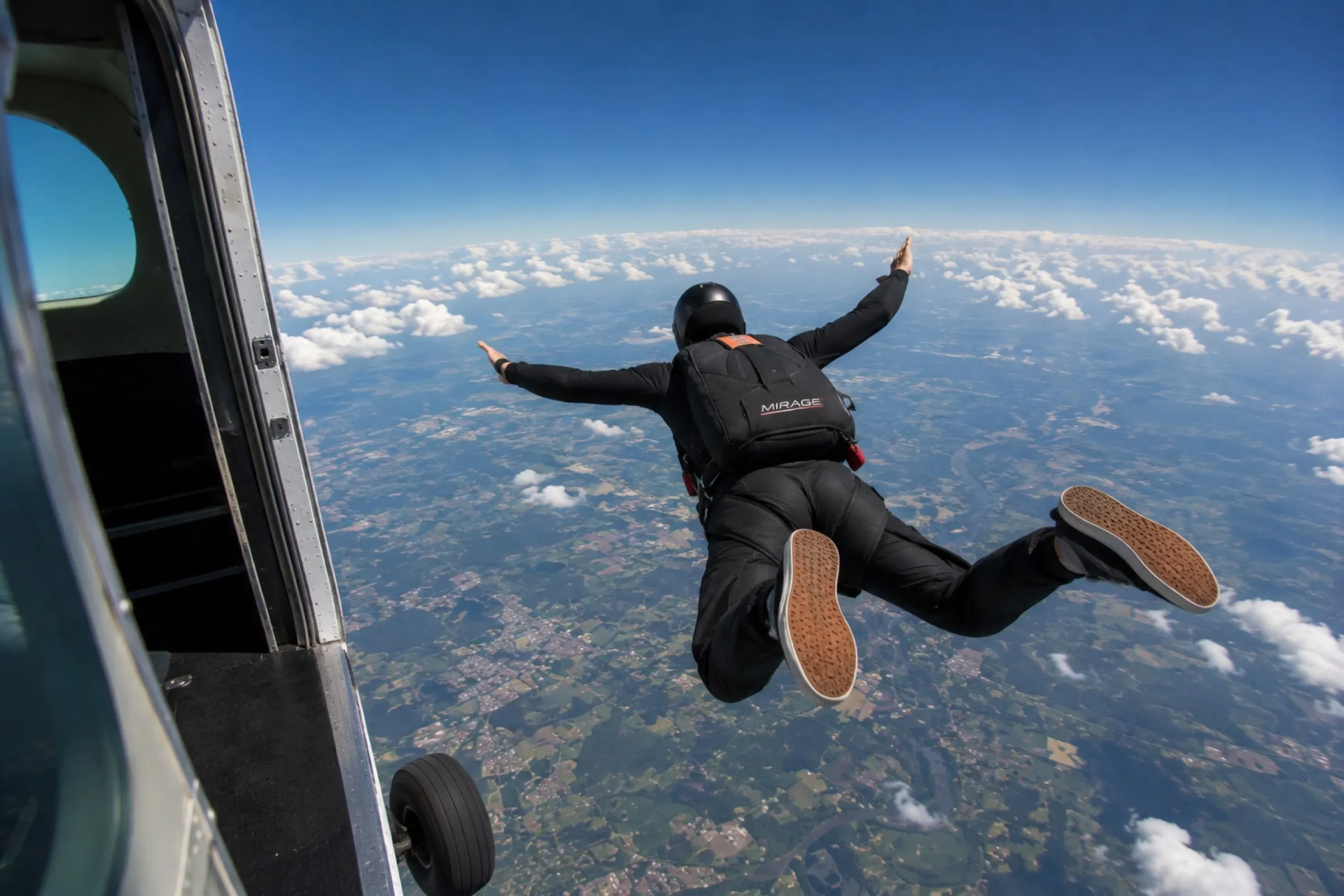
Adrenaline experiences in Lombardy (and just outside): 8 checked ideas
From tandem skydiving to the Verzasca Dam bungee, from indoor skydiving at Pero to rafting on the Adda: 8 adrenaline experiences in and around Lombardy, where to do them and who they suit.
Read the article
Guides
How much does a parachute cost? Skydiving gear prices in 2026
What a new sport parachute costs, part by part: container, canopies, AAD, accessories and running costs, using 2026 price lists.
Read the article
Guides
Extreme skydiving: disciplines, records and extreme sports in Italy
What extreme skydiving really means: the advanced disciplines, the stratospheric records, why a tandem is something else, and which extreme sports to try in Italy.
Read the article