Overcoming the fear of heights: vertigo and acrophobia
Updated on September 19, 2026 · 9 min read
What is fear of heights?
Fear of heights, or acrophobia, is a condition characterized by intense anxiety related to situations involving great heights. Sufferers may experience dizziness, a sense of instability, nausea, and even panic attacks. Those who suffer from vertigo often describe sensations of vertigo as feeling as if everything around them is spinning or swaying, creating a strong sense of instability and discomfort.
Often confused with simple vertigo, acrophobia is actually a specific phobia with very specific triggers, typically linked to traumatic experiences or generalized anxiety. Vertigo, on the other hand, represents a broader symptom that can arise from a variety of factors. Causes of vertigo include inner ear problems, neurological disorders, blood pressure problems, or other underlying medical conditions.
Ready to jump? Book your tandem with no advance payment.
Book nowIt's also important to distinguish between the different types of vertigo: peripheral vertigo, often linked to vestibular disorders, and central vertigo, associated with problems in the central nervous system. This distinction is essential to properly address the problem, as treatments can vary significantly depending on the type and cause of the vertigo.
Why are we afraid of heights?
Historically, this fear had an evolutionary role: it served to protect us from potentially lethal situations. However, in the modern context, it often becomes an obstacle that limits our daily lives and our experiences.
According to recent scientific studies, such as those conducted by Karen Adolph at the Infant Action Lab at New York University, a fear of heights may not be completely innate. Children gradually develop an awareness of their motor skills, avoiding situations they perceive as risky.
Common symptoms of fear of heights
The most common symptoms include:
- Intense anxiety
- Dizziness and nausea
- Excessive sweating
- Tachycardia
- Panic attacks
How to Eliminate Vertigo and Overcome a Fear of Heights
There are several effective strategies for dealing with and overcoming acrophobia. Here are some of the most recommended:
1. Gradual exposure Start by tackling slightly uncomfortable situations and gradually increase the difficulty. You could start by looking out from a low balcony, then gradually work your way up to higher positions.
2. Positive visualization Use mental visualization to imagine, in detail, successfully navigating high-altitude situations. This helps your brain prepare to react calmly in real situations.
3. Deep breathing Slow, deep breathing helps reduce anxiety by calming the sympathetic nervous system. Practice deep breathing before and during exposure to heights.
4. Relaxation techniques Yoga, meditation, and mindfulness can be extremely helpful in managing anxiety and fear. These techniques teach you to stay calm and centered in stressful situations.
5. Professional support Consult a therapist who specializes in cognitive behavioral therapy (CBT). This form of therapy helps identify and change the distorted thoughts that fuel fear.
Skydiving: A counterintuitive but effective solution?
Surprisingly, tandem skydiving can be a great way to overcome a fear of heights. Although it may seem counterintuitive, jumping out of a plane can:
- Offer direct and controlled exposure
- Guarantee safety thanks to the presence of expert instructors
- Stimulate a sense of personal achievement
Why freefall does not feel like standing over a drop
Because that feeling needs a close, fixed reference point: a railing, a wall, the ground right below you. At 4,200 metres it simply is not there, and after the first few seconds your speed stops increasing. Your body does not register falling, it registers a steady push of air.
There are no nearby reference points
From the aircraft door the landscape looks like a map, not a cliff: your brain cannot work out how far the ground is, so the fear has nothing to hold on to. It is one of the reasons many people who suffer from vertigo can still jump, as we explain in skydiving and vertigo.
Your speed becomes constant
The stomach-in-your-throat feeling of a roller coaster comes from acceleration, not speed. In freefall the acceleration lasts a few seconds: the air then balances your body weight and you stay at around 200 km/h for 50 to 60 seconds, as if resting on a cushion of air. The exact numbers are in how long freefall lasts.
Here are the most common fears against what actually happens:
| What you fear | What actually happens |
|---|---|
| The drop under your feet | At 4,200 metres there are no close references: the ground looks like a map |
| Stomach in your throat | It lasts a few seconds: speed then settles at around 200 km/h |
| Having to decide when to jump | Your instructor decides: the exit is his movement, you do nothing |
| Not being able to breathe | You breathe normally: the wind is strong, but air goes in and out |
| Losing control | It stays with your instructor: the canopy opens at around 1,500 metres |
| That it lasts too long | 50 to 60 seconds of freefall, then 5 to 10 quiet minutes of flight |
What happens to your body before and during the jump
Racing heart, short breathing, cold hands, sometimes shaky legs while the harness goes on: that is adrenaline, the same reaction you would have before an exam. During the 25 minutes of the climb the tension builds because you have time to think; at the exit the wind takes over. Under the canopy you get 5 to 10 minutes of silence and scenery, the part almost everybody remembers.
What if I freeze at the door?
Nothing happens: nobody is pushed out and the final call belongs to your instructor. If you do not feel ready at that moment, you stay in and come back down with the aircraft.
Instructors deal with that instant every day: if you stiffen up they put you back into position and do the work, because you are attached to their body. Saying "I am afraid of heights" at the briefing is not a problem, quite the opposite: it gets every step explained more slowly.
What you can do in the days before the jump
You do not need to train: what lowers anxiety is removing unknowns.
- Watch a few tandem jump videos: knowing what you will see takes space away from fear of the unknown.
- Learn how the day works: 25 minutes of climb, 50 to 60 seconds of freefall, 5 to 10 minutes under the canopy, 2 to 3 hours in total.
- Sleep and eat normally: skipping breakfast does not calm anxiety, it amplifies it.
- Arrive without rushing: racing down the motorway means starting already tense.
- Tell your instructor; and if data reassures you, read how safe skydiving is.
A tandem jump is not therapy and does not replace a professional: if fear of heights affects your daily life, start with a specialist.
Differences between vertigo and fear of heights
It is important to clarify that vertigo and acrophobia are not the same thing, although they often coexist.
- Dizziness: sensation of unsteadiness or movement, often related to physical problems such as inner ear disorders.
- Acrophobia: irrational fear of heights, mainly psychological and anxiety-related.
In both cases, addressing the problem gradually and with the help of professionals can offer great benefits.
Fear of heights or fear of flying?
They are two different fears and they often do not come together: fear of heights is about edges, fear of flying is about being enclosed in something you do not control.
On a tandem jump they show up at different moments. The climb takes about 25 minutes with the door closed: for people with acrophobia it is usually the easy part, because there is no edge to look over. For people afraid of flying it is the part worth preparing, with the advantage of sitting next to your own instructor and knowing exactly how long it lasts. If you want to try, you can book your jump and mention it when you pick the date.
Overcoming a fear of heights takes time, patience, and often professional support, but it is certainly possible. Using gradual exposure techniques, deep breathing, and visualization, you can significantly reduce the symptoms of fear and vertigo.
If you want to test yourself in a direct and safe way, tandem skydiving is an effective and rewarding challenge that can transform your fear into a personal growth experience.
Frequently asked questions
- What is the difference between vertigo and acrophobia?
- Vertigo is a symptom: a sensation of unsteadiness or movement often linked to physical issues such as inner ear disorders. Acrophobia, on the other hand, is a specific phobia: an irrational fear of heights that is mainly psychological and anxiety-related. The two can coexist but have different causes and treatments.
- What are the most common symptoms of a fear of heights?
- The most common symptoms include intense anxiety, dizziness and nausea, excessive sweating, tachycardia and, in more severe cases, full panic attacks.
- How can you overcome acrophobia?
- Among the most effective strategies are gradual exposure, positive visualization, deep breathing, relaxation techniques such as yoga and mindfulness and, when needed, the support of a therapist specialized in cognitive behavioral therapy (CBT).
- Can skydiving help overcome the fear of heights?
- Yes, even though it may seem counterintuitive. A tandem jump offers direct but controlled exposure, guarantees safety thanks to expert instructors, and creates a strong sense of personal achievement, turning fear into an experience of growth.
- Can someone who suffers from vertigo do a tandem jump?
- In many cases, yes. During freefall at high altitude there are no ground reference points, so many people who suffer from vertigo do not feel the same sensation they experience in daily life and can enjoy the experience without problems.
- If I am afraid of heights, will I feel the drop during the jump?
- Almost always no. That sensation needs a close, fixed reference point, like the edge of a balcony: at 4,200 metres there is none, and the ground looks like a map. On top of that, after the first few seconds your speed settles at around 200 km/h, so you no longer feel acceleration, only wind.
- What happens if I freeze at the door?
- Nobody is pushed out: the final call belongs to your instructor. If you stiffen up he puts you back into the correct position and handles the exit, since you are attached to his body. If you decide not to jump, you stay in and land with the aircraft.
- Can I do a tandem jump if I am afraid of flying?
- They are two different fears. The climb lasts about 25 minutes, you sit next to your own instructor and you know exactly how long it will take: mentioning it at the briefing means being guided step by step. After the exit, only freefall and the canopy flight are left.
- What can I do in the days before to arrive calmer?
- Watch a few tandem jump videos, read how the day is structured, sleep and eat normally, get to the dropzone without rushing and tell the staff you are afraid of heights. You do not need to train: you need to remove unknowns.
Ready for your tandem jump?
Free, flexible booking with no advance payment. Over 400 five-star reviews.
Useful resources
Keep reading
Guides
AFF Course: The Complete 7-Level Path to Becoming a Skydiver
Why choose the AFF Course with Accademia di Paracadutismo? Discover the 7-level path, from theory to your internationally recognized license, with certified instructors and over 20 years of experience.
Read the article
Guides
How to Get Your Skydiving License
Discover how to earn your skydiving license through the AFF Course, an intensive program that prepares you to jump on your own. Accademia di Paracadutismo in Casale Monferrato offers safe training and experienced instructors to make your dream come true.
Read the article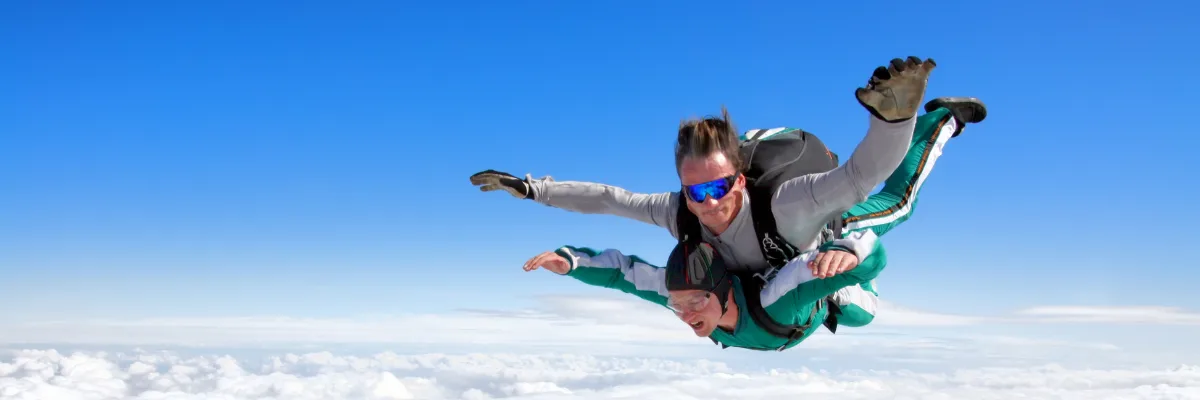
Guides
Skydiving: EVERYTHING you need to know - Quick 2026 Guide
Skydiving is an adrenaline-filled experience. Choose between a tandem jump or an AFF course to become a solo skydiver. 60 seconds of freefall at 200 km/h, then the parachute opens and the whole world is beneath you. An experience you'll never forget!
Read the article