Skydiving and Vertigo: Can You Jump if You Suffer from Vertigo?
Updated on September 19, 2026 · 9 min read
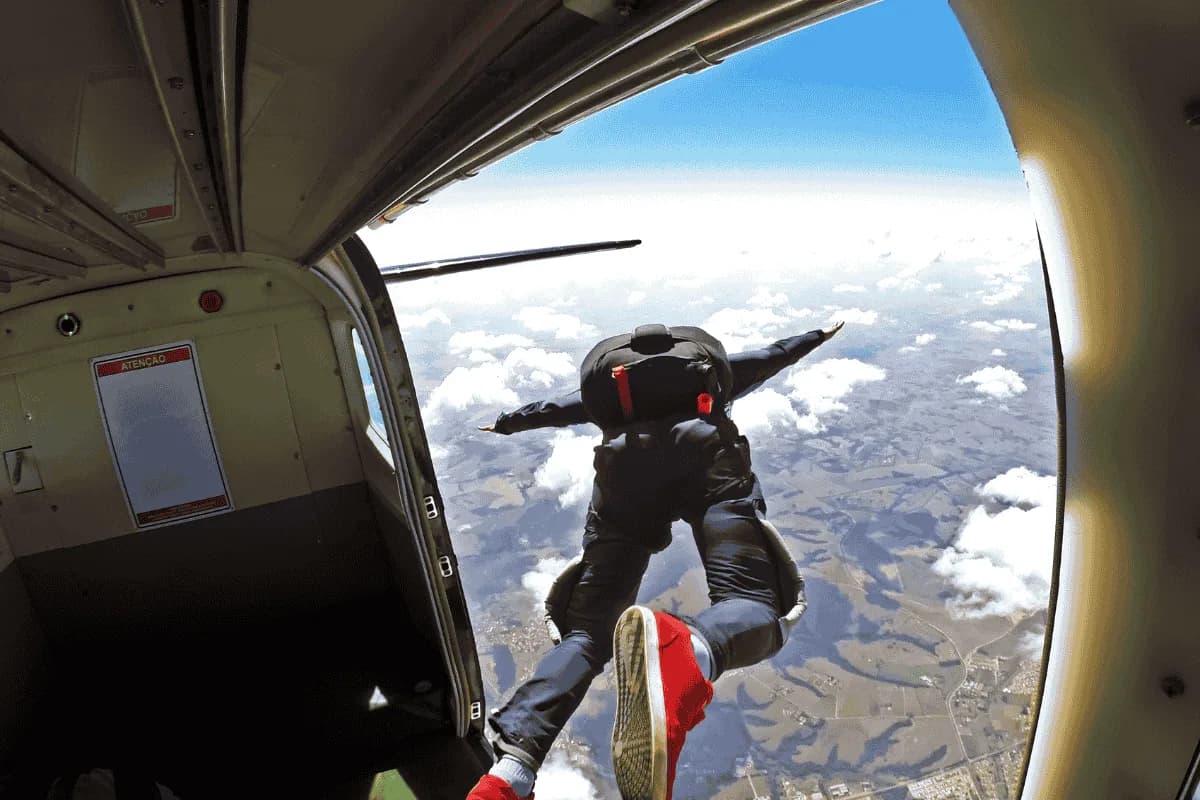
Of all the questions we receive from those who would like to book their first jump, one comes up more often than the others: “I suffer from vertigo, can I skydive?”. It's a perfectly legitimate doubt, because anyone who lives with vestibular disorders, dizziness or instability knows how debilitating the sensation can be. Yet, contrary to what one might think, skydiving and vertigo have a much less conflictual relationship than it seems. Indeed, a good portion of those who suffer from vertigo discover during a tandem jump that, in free fall, that discomfort simply does not arise.
In this article, we'll explain why this happens, what actually happens to your body at 4,200 metres, the difference between clinical vertigo and fear of heights, and when it's best to have a medical checkup before booking your skydive.
Vertigo and skydiving: what vertigo really is
Ready to jump? Book your tandem with no advance payment.
Book now
Before understanding how the body reacts during a parachute jump, it is worth clarifying what vertigo really is. Technically it is not a “fear”, but a physical symptom: an illusory sensation of movement, in which the environment around you appears to rotate, oscillate or tilt, even though you are perfectly still. It is a disorder related to the vestibular system, the inner ear system that manages balance and spatial orientation.
Vertigo can have many different origins: a simple transient labyrinthitis, benign paroxysmal positional vertigo (the famous “BPPV”), neck problems, drops in blood pressure, vestibular migraines or, more rarely, neurological disorders. Confusing it with a fear of heights is one of the most common mistakes, because although the symptoms may overlap (instability, nausea, sweating), the causes are profoundly different: vertigo is a physical symptom of the inner ear, acrophobia is a fear. For the psychological side we have dedicated a specific article to overcoming the fear of heights, vertigo and acrophobia.
The key point, however, is another: skydiving doesn't stress the vestibular system in the same way that situations that make you dizzy in everyday life do. And here things start to get interesting.
Why you don't feel dizzy in free fall
When you look out from a twentieth-floor balcony or climb a tall ladder, your brain receives a huge amount of depth information: it sees the floor below you, the walls to your sides, objects that become progressively smaller. This multitude of visual reference points is exactly what causes that empty feeling in the stomach, the instability and, in those who are predisposed, actual dizziness.
In free fall from 4,200 metres the opposite happens. At that altitude you have no fixed point of reference: the ground is too far away to be perceived as “below you”, and the horizon opens up 360° in a vastness that the brain cannot translate into depth. The result is that, paradoxically, you don't feel the sensation of “falling”, but rather that of floating suspended in a flow of air. This is why, when we are asked whether you feel dizzy during a tandem jump, the honest answer is: in the vast majority of cases, no.
Added to this is a second technical factor. During free fall the body stabilises in a horizontal position, parallel to the ground, at a speed of about 200 km/h. The airflow literally supports the skydiver, eliminating that feeling of “emptiness” you experience when looking down from the ledge of a building. The vestibular system perceives a constant and uniform pressure, not the variability that triggers vertigo attacks.
Height-related dizziness and clinical vertigo: the difference that changes everything
To understand whether skydiving is really an activity compatible with your case, it's essential to make a clear distinction. Vertigo is essentially divided into two large families, and their behaviour during a parachute jump is completely different.
So-called “height-related” vertigo is not vertigo in the medical sense: it is a neurological reaction to the conflict between what the eyes see (the void) and what the vestibular system perceives (body stability). It's a transient phenomenon that occurs only in the presence of clear visual landmarks. In skydiving, as we've seen, these landmarks disappear.
Clinical vertigo, on the other hand, such as labyrinthitis, paroxysmal positional vertigo or vestibular syndromes, has a specific physiological origin and is activated by specific stimuli (rapid head movements, changes in position, pressure in the ear). In these cases, it is always advisable to speak to your doctor or an ENT specialist before booking a jump. Not because skydiving is dangerous in itself, but because the ascent phase in the plane, with the change in pressure, could in some cases stress the inner ear.
This table sums up the difference in practical terms, because this is what the answer to “can I jump?” really depends on:
| Aspect | Height-related dizziness | Clinical (vestibular) vertigo |
|---|---|---|
| What it is | A neurological reaction to the conflict between what the eyes see (the void) and the stability the body perceives | A physical symptom with a specific physiological origin: labyrinthitis, positional vertigo, vestibular syndromes |
| When it kicks in | Only when clear visual landmarks are present: balconies, ladders, ledges | With specific stimuli: rapid head movements, changes in position, pressure in the ear |
| What happens in free fall | It doesn't kick in: at 4,200 metres the landmarks disappear and the sensation is of floating in the airflow | It usually doesn't kick in either, but the climb and the change in pressure can stress the inner ear |
| What to do before the jump | No particular precautions: on a tandem the instructor handles every technical aspect | Talk to your doctor or an ENT specialist first |
Tandem skydiving if you suffer from vertigo: what you need to know
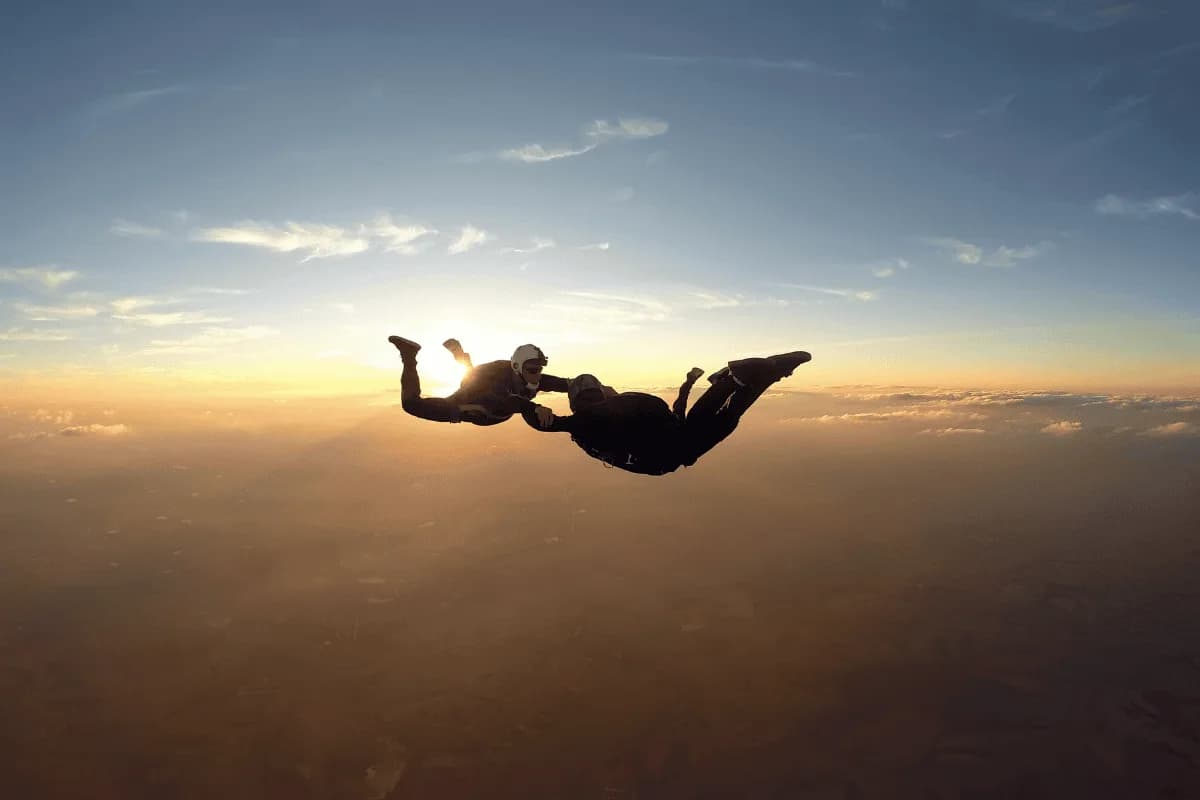
Tandem skydiving is the best solution for those who want to try the experience despite a predisposition to vertigo. The reason is simple: during the entire tandem jump you're connected face-to-face with a certified instructor who manages every single technical aspect. You don't have to maintain any particular posture, you don't have to control the parachute opening, you don't have to manage the landing. Your only task is to breathe, look around and live the experience.
This is important because it eliminates the additional stress that could trigger dizziness: the instructor keeps the body stable, controls the position, and once the parachute opens the descent becomes so smooth and silent that many describe it as the most relaxing part of the entire flight. Even during the descent phase with the open parachute, the manoeuvres are progressive and never sudden, precisely to avoid creating discomfort. If it helps to understand how the technical side works, we explain it all in how safe it is to jump with a parachute.
When is it best to consult your doctor before skydiving
That said, prudence never hurts. There are some situations in which we recommend you have a medical check-up before booking your skydive: if you have had episodes of severe vertigo in the last few weeks, if you are being treated for active vestibular disorders, if you suffer from Meniere's or similar syndromes, if you have recent middle ear problems, or if you take medications that can alter your balance.
In all these cases, a medical opinion allows you to approach the jump with complete peace of mind. It's exactly the same approach we would take with any other intense sporting activity: nothing to worry about, just common sense. For all other requirements regarding who can jump, you can consult our page with everything you need to know about skydiving.
Vertigo and skydiving: the experience of those who have already been there
What we've noticed in more than twenty years of jumps at Casale Monferrato Airport is that vertigo, during flight, rarely behaves as expected. People who can't climb a three-metre ladder describe experiencing the opening of the plane door with a totally different, almost dilated, feeling. The altitude at which the tandem jump is performed is so high that the brain is unable to activate the mechanisms typical of vertigo.
In short, those who suffer from vertigo often start from an unexpected vantage point: expectations are low, and the reality of the parachute jump ends up completely overturning them. If you recognise yourself in this description, tandem skydiving can be the safest and most supported way to discover a version of yourself you probably didn't know. Book your jump now and put yourself to the test.
Frequently asked questions
- Can I skydive if I suffer from vertigo?
- Yes, in most cases it's possible. In free fall, the visual cues that cause dizziness in everyday life are missing, so at 4,200 metres the brain doesn't perceive the sensation of 'falling', and the typical symptoms don't activate. If you suffer from active vestibular disorders, we still recommend seeking medical advice before jumping.
- Do you feel dizzy during free fall?
- No, dizziness isn't usually felt. The high altitude and lack of a fixed reference point eliminate the visual conflict that triggers dizziness. The predominant sensation is that of floating suspended in the airflow, not falling.
- What's the difference between vertigo and fear of heights?
- Vertigo is a physical symptom related to the vestibular system of the inner ear, while fear of heights (acrophobia) is a psychological phobia. They may present similar symptoms, such as unsteadiness and nausea, but have completely different causes and require different approaches.
- I suffer from labyrinthitis. Can I do a tandem jump?
- If labyrinthitis is active or you've had it recently, it's best to postpone your jump and consult an ENT doctor. Once the acute phase is over, most people can jump without any problems, but getting medical approval is always the most prudent course of action.
- Is tandem or the AFF course better if I have vertigo?
- Without a doubt the tandem jump. The instructor manages every technical aspect of the jump and you can focus only on the experience, without having to maintain positions or perform manoeuvres. The AFF course is instead recommended only after verifying that you do not have significant vestibular problems.
- Should I tell the instructor that I suffer from vertigo?
- Yes, it's always a good idea to mention this during the briefing. The instructor may adjust some small manoeuvres during the descent with the parachute open, avoiding overly sharp turns, to make the experience even more comfortable.
- Can the change in pressure during the climb cause problems?
- The climb to 4,200 metres takes around 25 minutes and is gradual, so for most people it is not an issue. If you have active vestibular disorders or recent middle ear problems, though, this is exactly the phase to discuss with an ENT specialist before booking.
- Can you feel dizzy under the open canopy?
- Rarely. After deployment at around 1,500 metres you get 5-10 minutes of canopy flight with progressive, never sudden manoeuvres. If you mention your vertigo during the briefing, your instructor will avoid sharp turns and keep the descent smooth.
- How long does the most intense part of the jump actually last?
- Less than you imagine: free fall lasts around 50-60 seconds at about 200 km/h, then come 5-10 minutes of calm canopy flight. The whole experience at the drop zone takes 2-3 hours. The details are in how long free fall lasts and how fast you go.
Ready for your tandem jump?
Free, flexible booking with no advance payment. Over 400 five-star reviews.
Useful resources
Keep reading
Guides
What to Wear for Skydiving: Complete 2026 Guide
Find out what to wear for skydiving and what to put on for a tandem jump, with practical tips on skydiving clothing, shoes, and the ideal outfit for your first jump in total comfort and safety.
Read the article
Guides
Indoor Skydiving vs Real Skydiving: What to Choose in 2026
A comparison between indoor skydiving and real skydiving in 2026, covering experience, costs, safety, and benefits to help you choose the flying activity that suits you best.
Read the article
Guides
Competitive Skydiving in 2026: How the Disciplines Are Changing
Indoor skydiving or real skydiving — which is better? Differences, costs, safety, benefits, and the flying experience, to help you choose the skydiving option best suited to your needs.
Read the article