

In recent years more and more people are approaching the world of skydiving starting from a very concrete question: is it better to try theindoor skydiving in the wind tunnel or jump straight into the real parachuting From a plane? The growth of flight tunnels across Europe and the increase in tandem jumps have made this option more accessible than ever, but also more confusing for first-time jumpers.
In reality, indoor skydiving and real-life skydiving aren't two competing worlds, but rather two different, complementary experiences with specific goals, sensations, and benefits. Understanding the differences is essential to making an informed choice and fully enjoying your first contact with human flight.
What is indoor skydiving and why has it become so popular?
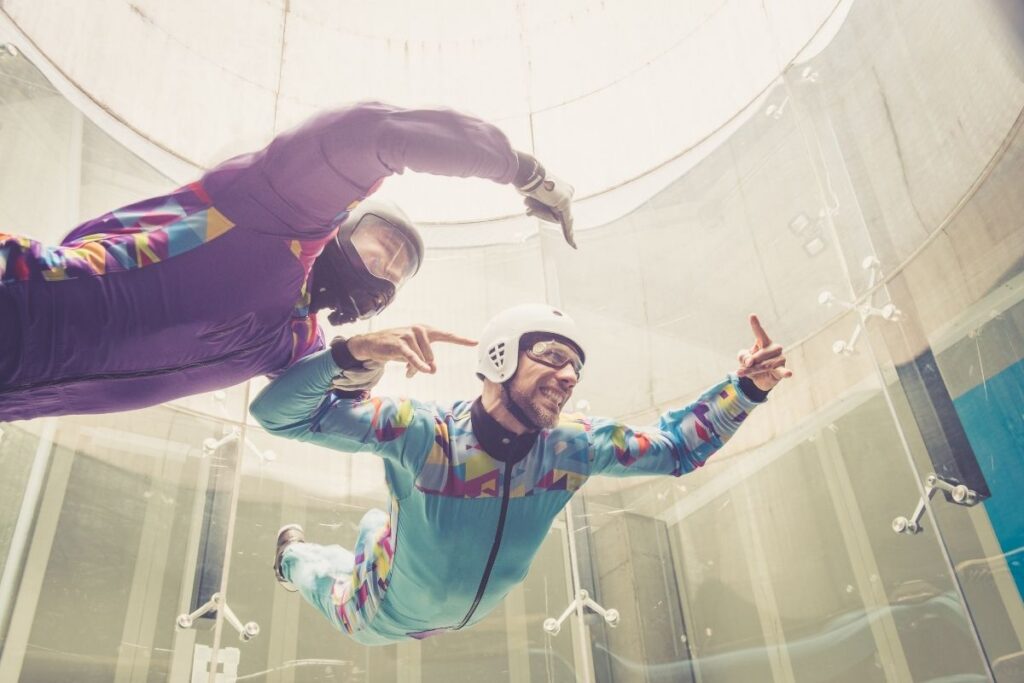
L’indoor skydiving, also known as wind tunnel flight, uses a powerful vertical tunnel that generates enough airflow to support the human body, simulating the sensation of freefall. In recent years, this discipline has seen enormous growth thanks to its accessibility, the possibility of flying year-round, and the absence of variables such as weather and altitude.
From an experiential perspective, indoor skydiving is extremely controlled. The environment is closed, the air speed is adjustable, and the instructor is always just a few centimeters away. This makes the wind tunnel particularly suitable for those who want to overcome initial fear, those seeking an adrenaline-filled yet manageable activity, or those seeking technical and repeatable training.
It is no coincidence that today the wind tunnel is considered a fundamental tool also in the sport parachuting: freefly, formation skydiving and VFS athletes use it to perfect posture, stability and body control, reducing learning time and costs.
What is real skydiving and why it remains irreplaceable
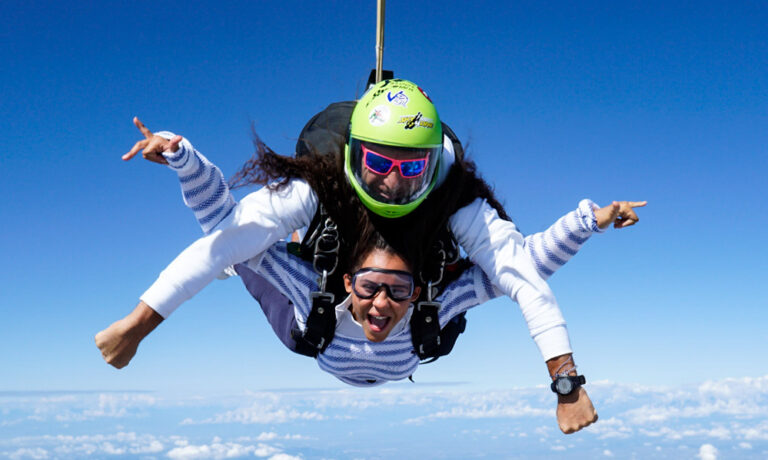
The real parachuting, on the other hand, is the complete experience of jumping from a high-altitude plane. It includes everything that makes skydiving unique: the ascent, the door opening, the moment of launch, the free fall in the open sky, and the gliding flight until landing.
Unlike the tunnel, much more intense emotional and sensory factors come into play here. The actual height, the view, the natural wind, the perception of space and time make skydiving a profoundly transformative experience. This is why many people describe their first jump as a personal, not just sporting, turning point.
From an educational standpoint, real skydiving is the only way to obtain certifications, licenses, and official progressions. No wind tunnel can replace learning safety procedures, canopy management, emergencies, and landing, which are an integral part of the skydiving outdoor.
Differences in experience: simulation versus reality
The comparison between indoor skydiving and real-life skydiving inevitably begins with the quality of the experience. In a wind tunnel, the sensation of flight is physically real, but the void, the altitude, and the transition between freefall and parachute flight are completely missing. It's a more "technical" experience, focused on body control and positioning.
In real skydiving, however, freefall is only part of the equation. The context amplifies every sensation: the sound of the wind, the view from above, the adrenaline rush of the jump, the sudden calm under the canopy. It's a more complex and intense experience, one that profoundly engages the mind and body.
For this reason, those looking for an exciting but gradual activity often find indoor skydiving an ideal first step, while those wanting a powerful, memorable and “unfiltered” experience tend to choose the tandem jump directly.
Costs: what's really worth it?
One of the most discussed aspects concerns the costsAt first glance, indoor skydiving may seem cheaper, but the comparison must be made carefully. In the tunnel, you pay by flight time, generally in minutes, and to achieve an amount of "free fall" comparable to a real jump, multiple sessions are required.
A tandem jump offers a complete experience in just a few seconds, including flight, freefall, parachute deployment, and landing, often at a competitive price compared to more advanced indoor packages. However, wind tunnels become convenient when the goal is repeated training, especially for those who want to improve technique and stability without having to worry about the logistical costs of flying, altitude, and weather.
In short, indoor skydiving is cost-effective for practice and training, while real skydiving offers a very high emotional and experiential value from the very first jump.
Security: Perception and Reality
Another central theme is the safetyIndoor skydiving is perceived as extremely safe, thanks to the controlled environment and constant presence of instructors. Accidents are rare and generally minor.
Real skydiving, despite being an extreme sport, is now much safer than you might think. Modern equipment, reserve parachutes, automatic deployment systems, and rigorous procedures have dramatically reduced risks. The main difference lies in perception: jumping out of a plane is more impressive, but this does not mean that it is less regulated or less controlled.
What to choose based on your goals
The choice between indoor skydiving and real skydiving depends primarily on what you're looking for. If your goal is to experience the sensation of flight gradually, easily, and without any particular barriers, a wind tunnel is an excellent choice. If, on the other hand, you want a complete, emotional, and authentic experience, Real skydiving is irreplaceable.
For those who dream of becoming a sport skydiver, combining the two experiences is the best solution today. The wind tunnel accelerates learning and improves technique, while the open sky teaches everything that makes skydiving what it truly is.
Indoor and outdoor: two paths that meet
More and more schools and academies are integrating indoor skydiving and real skydiving in structured training courses. It's no longer a matter of choosing one over the other, but of understanding when and how to use them. The tunnel prepares, the sky completes. Together, they offer a more informed, safe, and rewarding flight experience.
Book a launch now
Why choose our skydiving school?
If you are looking for a place to try a I parachuted for the first time, Casale Monferrato It's definitely an excellent choice!